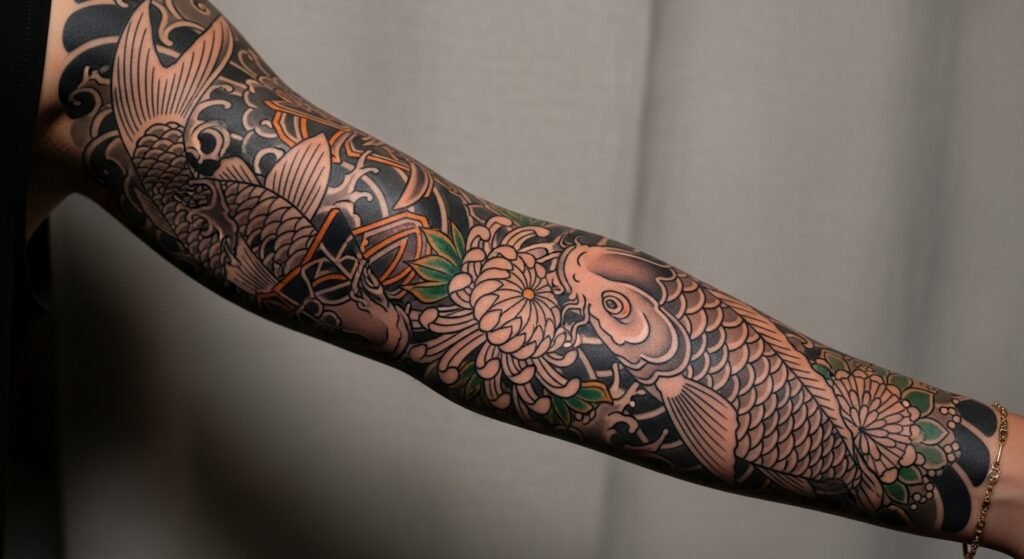
Sitting in a consultation, scrolling for inspiration at midnight, or finally committing to a full-arm piece—you know the feeling when a design grabs you and won’t let go. Japanese traditional tattoo sleeves deliver bold storytelling, sweeping composition, and color that ages into a living work of art. If you’re searching for a Japanese traditional tattoo sleeve idea that’s colorful and breathtaking, this list collects 24 directions you can bring to your artist.
These Japanese traditional tattoo sleeve ideas cover classic motifs—koi, dragons, geisha, phoenix—plus modern twists that use neo-traditional color palettes, fine-line accents, and blackwork grounding. You’ll find style breakdowns, placement notes, artist-search tips, and realistic aftercare guidance for healing, fading, and touch-ups.
Before your session, consider a light numbing cream for sensitive placements; I often recommend Zensa numbing cream 5% topical anesthetic when people ask about rib or inner-arm pain. After major sessions, a layer of Saniderm second-skin bandage can protect your new work for the first 48–72 hours while you rest. Keep scrolling—each entry has its own photo prompt, design notes, artist tips, and healing advice.
- Koi and Lotus Full-Flow Sleeve — Vibrant Upward Journey
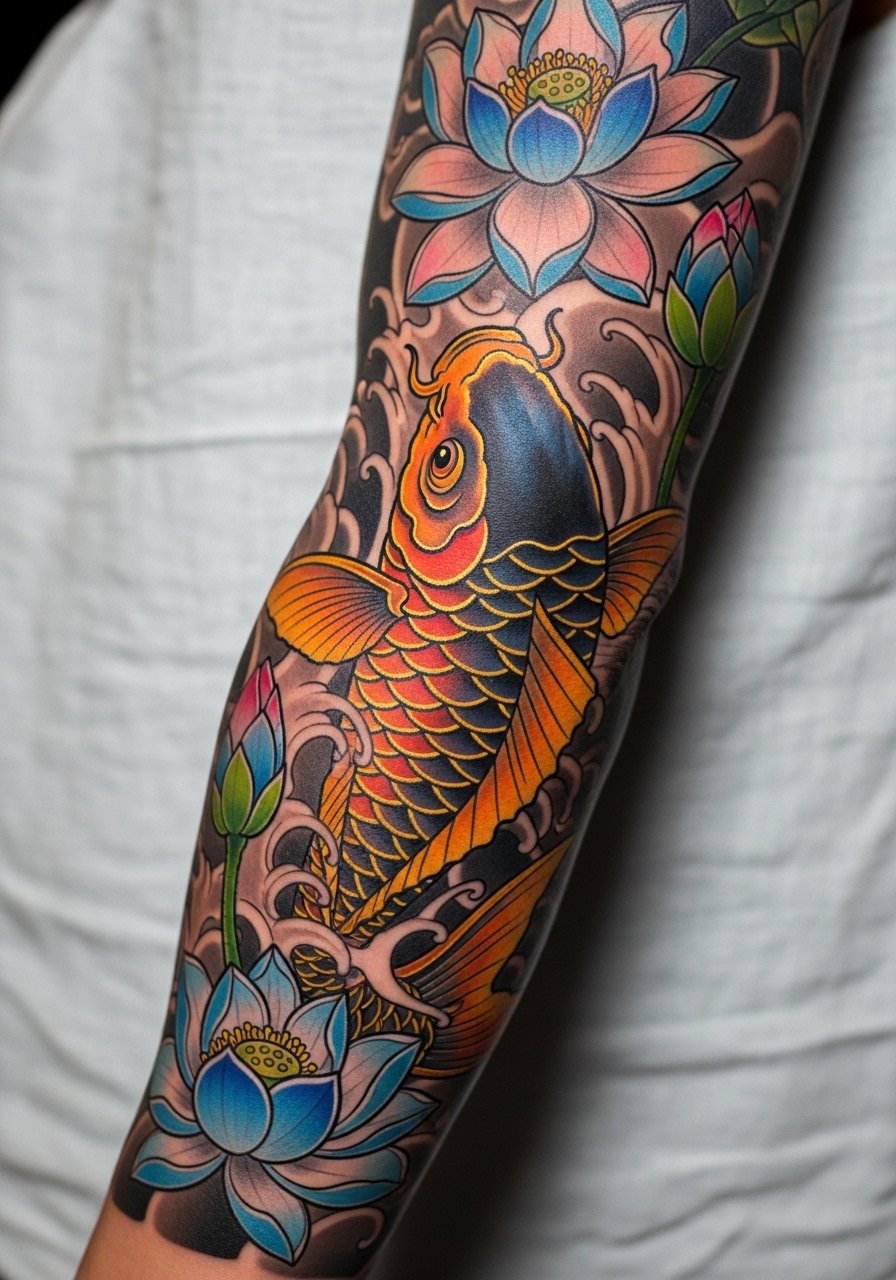
This classic tells a story: koi swimming upstream toward transformation. The composition loops around the arm, using water and wind bars to guide the eye. Expect bold outlines, saturated orange and indigo fills, and layered lotus petals to create depth. First-timers who want symbolic color will love it; collectors appreciate the negative-space flow across the elbow.
Style & Design Details
- Tattoo style: Japanese traditional/irezumi with neo-traditional color saturation
- Recommended size: Full sleeve (palm to shoulder)
- Best placements: Full arm, half-sleeve with shoulder cap, wrapping forearm (wraps read best on curved surfaces)
- Color vs. blackwork: Color-forward (deep oranges, indigo blues, gold highlights)
- Design elements: thick sumi outlines, flat color fills, subtle gradient shading, wind bars, lotus clusters, scale detailing
- Longevity note: solid color blocks last decades if sun-protected; thin highlights may need touch-ups after years
- Who it suits: medium-to-olive skin tones show rich color well; great for symbolic, narrative sleeves
Finding the Right Artist
Look for portfolios labeled irezumi or Japanese-style with consistent scale work and clean outlines. Ask to see healed photos—color saturation can differ after healing. Avoid an artist who mostly does small blackwork if you want heavy color saturation. Find pros on Instagram tags like #irezumi or local shop walk-ins and ask about session pacing for full sleeves. A seasoned artist is best for scale and flow.
Aftercare & Healing Tips
Leave compression-style bandage as recommended; after 48–72 hours, wash gently twice daily with fragrance-free soap and pat dry. Keep the area moisturized with a thin layer of unscented lotion (I use Lubriderm during peeling). Avoid strong sun for at least 4–6 weeks; long-term, apply SPF 50 when exposed to sunlight to protect the orange and indigo pigments.
- Fiery Dragon and Cloud Sleeve — Dynamic Motion, Bold Contrast
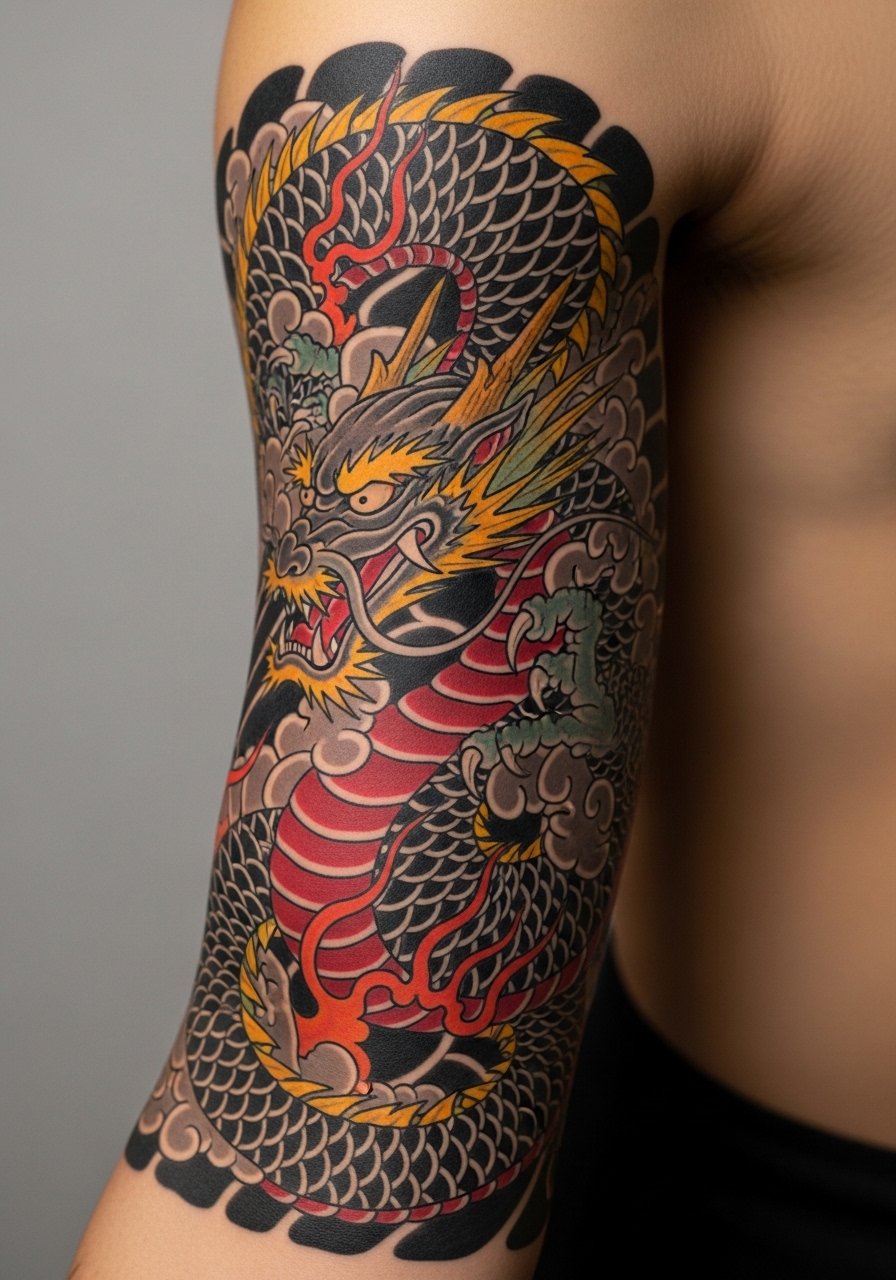
A dragon sleeve reads like motion itself: twisting body, spined scales, and expressive claws. Use heavy black outlines and selective color pops—crimson flames and teal clouds—to keep contrast alive. Ideal for someone who wants dramatic movement and a mythic tone.
Style & Design Details
- Tattoo style: Traditional Japanese with bold blackwork anchors
- Recommended size: Half to full sleeve (bicep wrap recommended)
- Best placements: Upper arm to elbow (shows muscle flow), full arm for dramatic effect
- Color vs. blackwork: Balanced—black anchors with selective reds/yellows
- Design elements: scales, dorsal spines, dynamic clouds, wind bars, flame highlights
- Longevity note: black outlines stay crisp longest; reds may dull faster without SPF
- Who it suits: people who favor strong silhouettes and mythical themes
Finding the Right Artist
Search portfolios with dragon motifs and crisp scale work. Ask about needle sizes used for scales and whether the artist staggers sessions for color saturation. Red flags: inconsistent line thickness, blowouts around fine scales. An experienced irezumi-focused artist or a seasoned neo-traditional with Japanese work is ideal.
Aftercare & Healing Tips
Expect 2–3 weeks of peeling; use a fragrance-free lotion to reduce scabbing tightness. If your artist applies a second-skin wrap like Saniderm, keep it on the advised time and follow shop washing rules. For longer-term vibrancy consider a tattoo brightening balm after full healing.
- Phoenix Rising Sleeve — Warm Tones and Feathery Detail
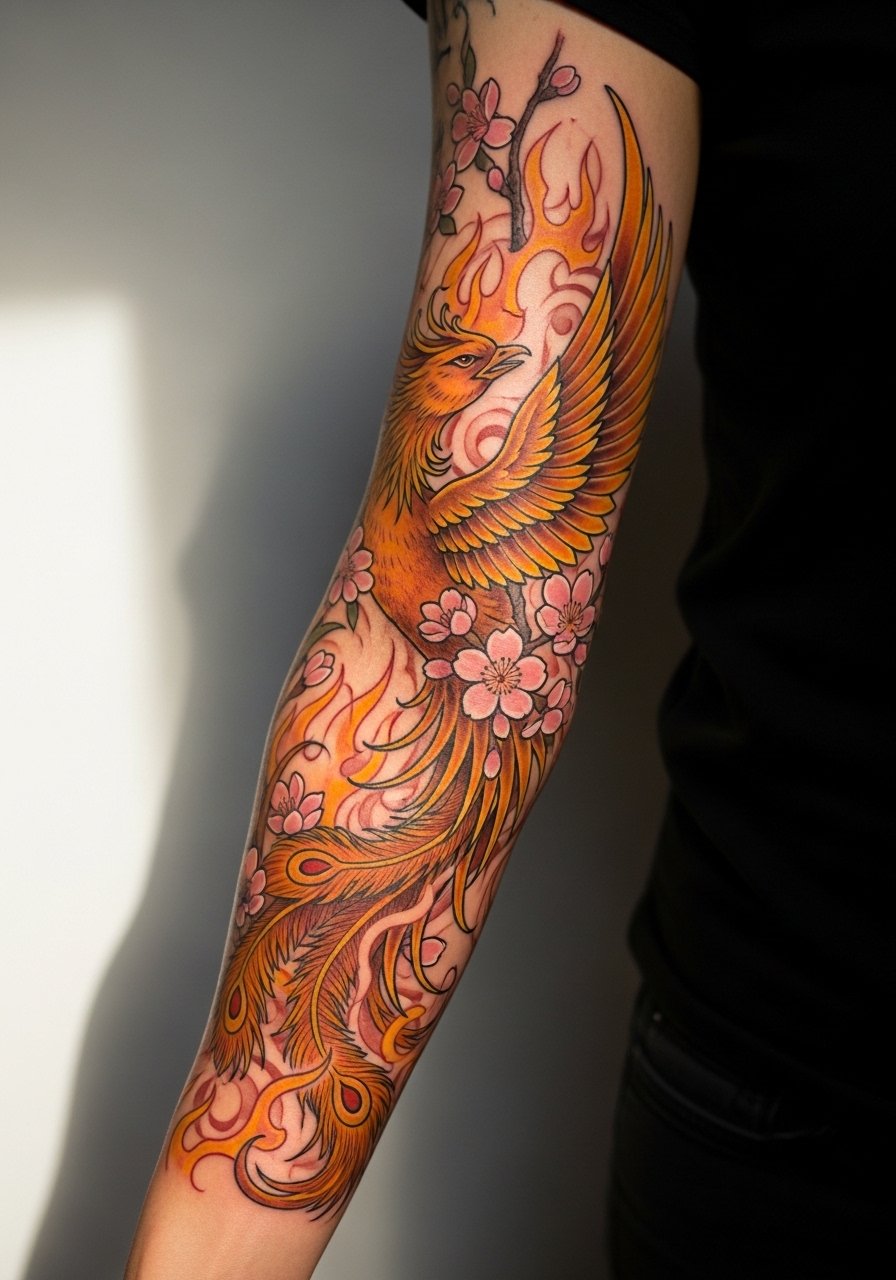
A phoenix sleeve blends fine feather detail with sweeping flame shapes. The feathered edges use a mix of single-needle fine lines and small stipple shading to keep the piece airy. This is a great pick if you want renewal symbolism with feminine color choices.
Style & Design Details
- Tattoo style: Irezumi-inspired with fine-line feather work
- Recommended size: Half to full sleeve depending on detail
- Best placements: Arm wrap, shoulder cap to forearm for movement
- Color vs. blackwork: Warm color palette (gold, amber, rose) with crisp black lines
- Design elements: feather micro-lines, stipple shading, flame swirls, cherry blossoms, negative space highlights
- Longevity note: fine lines can blur over many years if placed on high-friction areas—keep moisturized
- Who it suits: people who like poetic storytelling and soft palettes
Finding the Right Artist
Look for artists who list fine-line and Japanese on their profiles and show healed feather work. Ask about needle groupings (single-needle vs. 3RL for lines) and session pacing to keep lines crisp. Avoid artists who overuse thick linework for feather detail.
Aftercare & Healing Tips
Feather detail heals best with minimal scabbing. Use a thin, unscented lotion during the peeling phase and avoid heavy ointments that can clog detail. Continue SPF for color preservation. Consider scheduling a touch-up 6–12 months after completion if micro-lines soften.
- Hannya Mask and Peony Sleeve — Dark Drama, Floral Balance
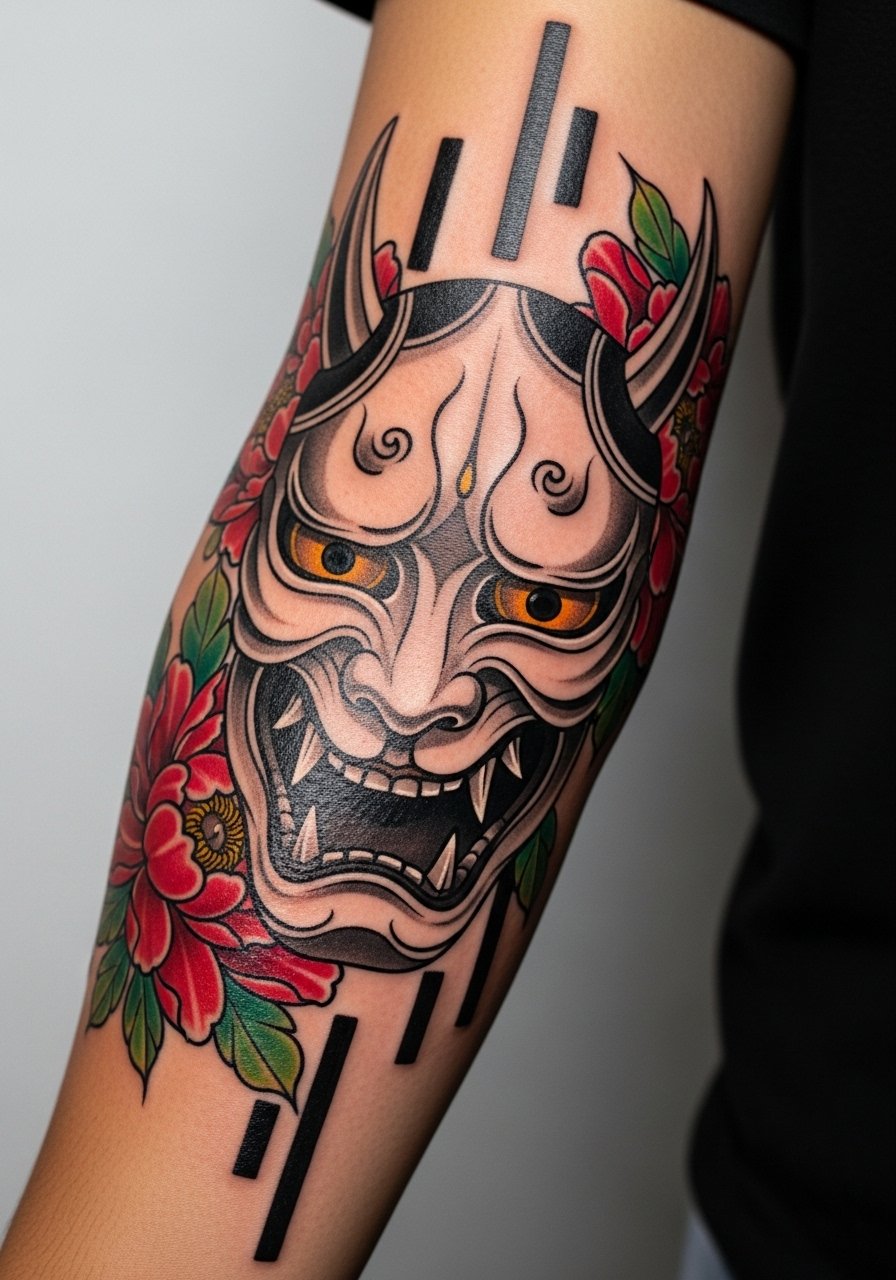
Hannya mask pieces carry emotional weight—anger, protection, or cautionary tales. Surrounding it with lush peonies softens the composition and adds color contrast. This pairing suits someone who wants a strong centerpiece with floral framing.
Style & Design Details
- Tattoo style: Traditional Japanese mask work with floral illustrative elements
- Recommended size: Palm-sized to half-sleeve focusing on forearm or bicep
- Best placements: Outer forearm, lower sleeve, chest wrap
- Color vs. blackwork: Black-dominant with deep red florals
- Design elements: mask shading, peony petals, negative space leaves, wind bars, dotwork accents
- Longevity note: black shading ages well; deep reds can require a color refresh later
- Who it suits: lovers of theatrical motifs and bold storytelling
Finding the Right Artist
Choose artists experienced with mask anatomy and expressive shading. Bring reference for the exact emotion and size you want. Ask how the mask will scale across curved areas to avoid distortion. Avoid artists who lack portfolio examples of large facial motifs.
Aftercare & Healing Tips
Masks rely on dense shading—avoid friction from tight sleeves during early healing. Gentle twice-daily wash, thin lotion layers, and avoid soaking for two weeks. A final color touch-up after 6–12 months is common for deep reds.
- Oceanic Samurai Sleeve — Subdued Palette, Structural Lines
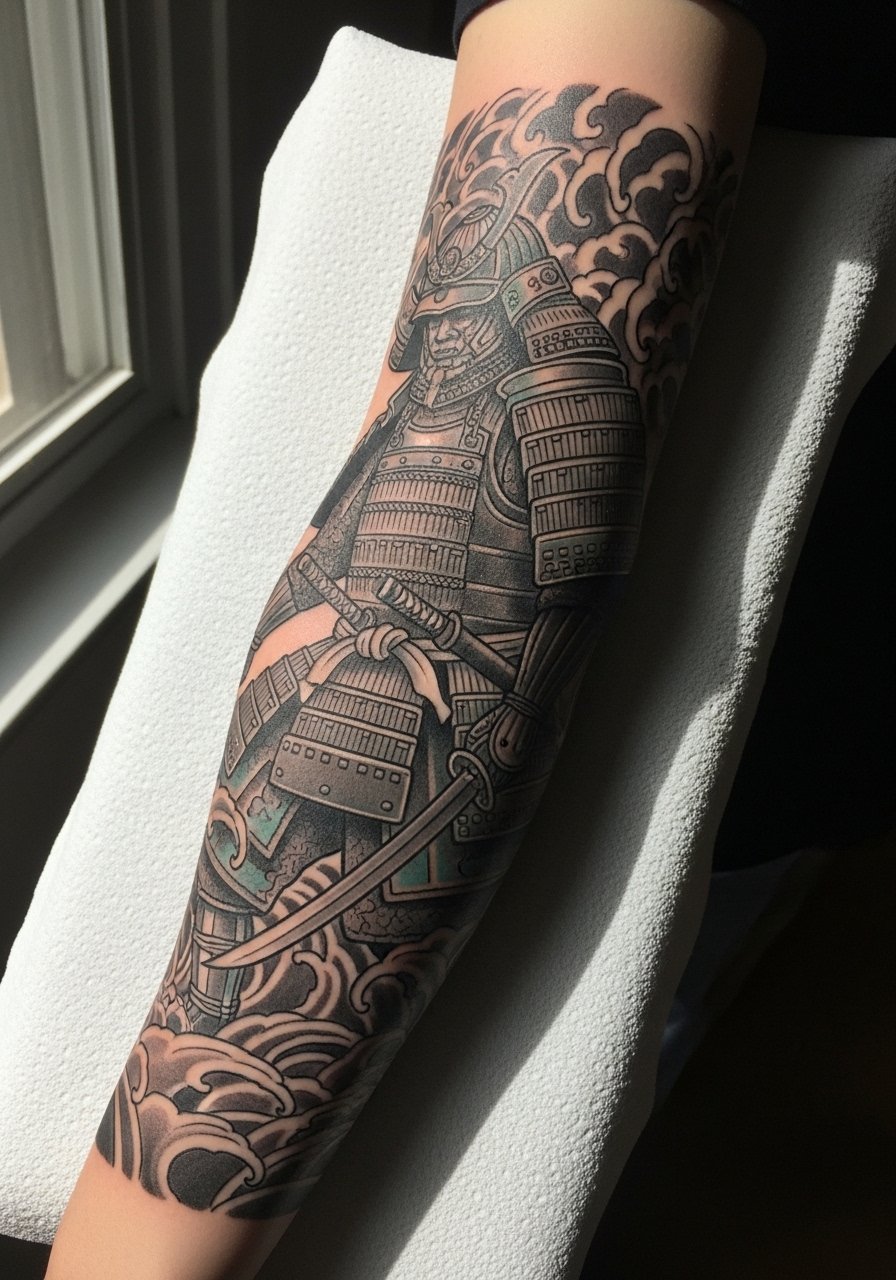
Combine samurai imagery with ocean motifs for a stoic composition. Use charcoal greys and muted teals instead of saturated primaries for a modern, vintage vibe. Structural plate armor and wave patterns give the sleeve strong rhythm and visual anchors.
Style & Design Details
- Tattoo style: Japanese illustrative with muted color grading
- Recommended size: Half to full sleeve depending on scene complexity
- Best placements: Upper arm to forearm wraps; chest integration for narrative
- Color vs. blackwork: Mostly black/grey with muted teal accents
- Design elements: armor plates, wave crests, sakura petals, stipple shading, bold outlines
- Longevity note: greys hold well; muted colors can fade unevenly if sun-exposed
- Who it suits: fans of samurai aesthetics and restrained palettes
Finding the Right Artist
Look for portfolio images showing armor detail and scene composition. Ask how the artist stages multiple focal points so nothing competes visually. A seasoned illustrative artist who understands composition is ideal.
Aftercare & Healing Tips
Greys and muted pigments respond well to consistent moisturizing and limited sun. Use a fragrance-free soap for the first two weeks and apply SPF once healed to protect teal accents.
- Tsukumogami Sleeve — Playful Yokai and Object Spirits
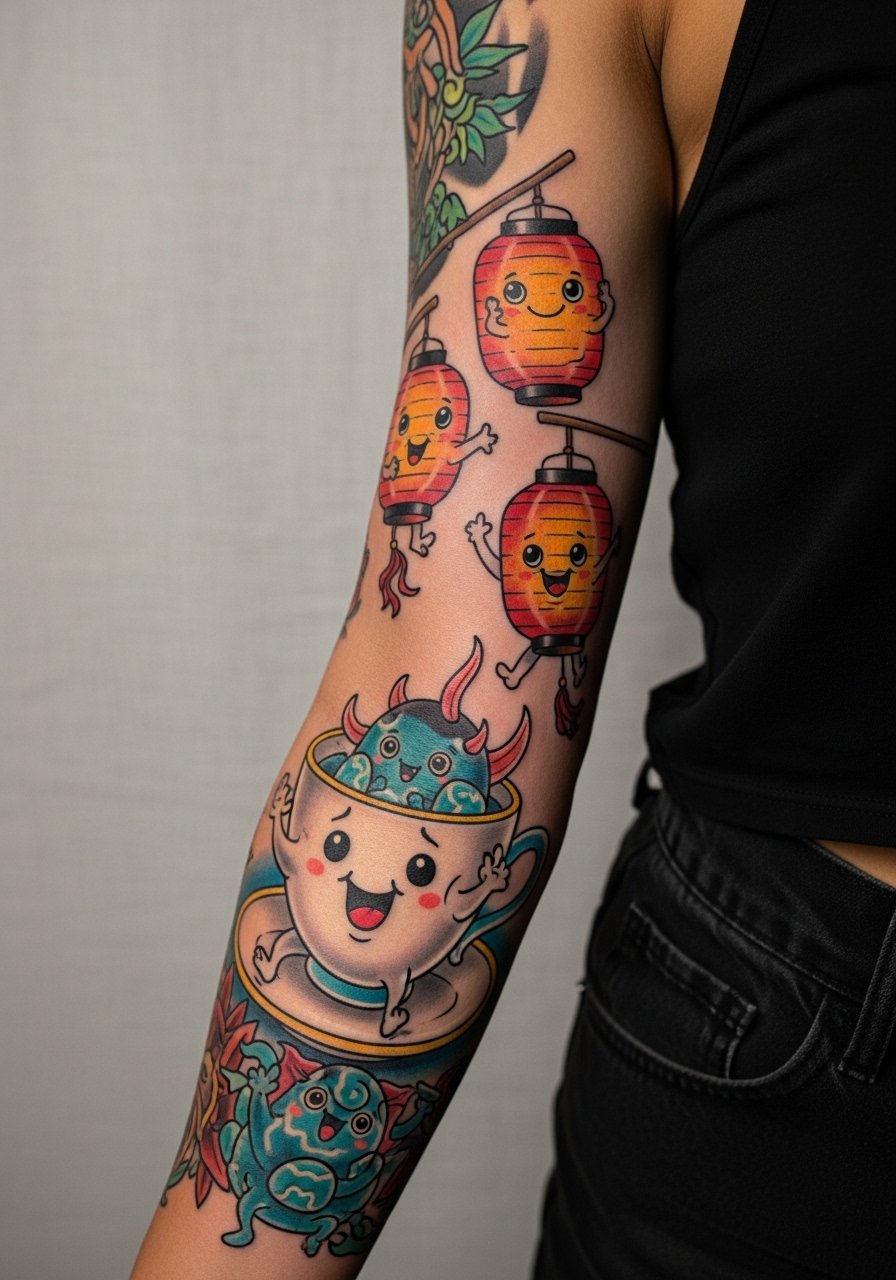
For a whimsical take, tsukumogami (object spirits) let you combine playful characters and bold color. Think animated lanterns, smiling teapots, and creaky geta with personality. This is perfect for someone who wants traditional motifs with a cute twist.
Style & Design Details
- Tattoo style: Neo-traditional Japanese with illustrative character work
- Recommended size: Quarter sleeve to full sleeve depending on number of characters
- Best placements: Outer arm, full sleeve for a storybook flow
- Color vs. blackwork: Color-forward with jewel tones and black outlines
- Design elements: character expressions, textured fills, negative-space speech bubbles, cloud motifs, small dot highlights
- Longevity note: small color blocks need touch-ups sooner than larger filled areas
- Who it suits: collectors who like playful narratives and character-driven sleeves
Finding the Right Artist
Search for artists who do neo-traditional characters and show a playful line quality. Ask how they design expressions and whether they can create custom flash. Avoid artists who lack experience in expressive facial shading for small motifs.
Aftercare & Healing Tips
Smaller characters can crust quickly—moisturize gently and avoid picking. Use an unscented lotion during peeling and keep sun exposure minimal on small color spots.
- Chrysanthemum and Wave Sleeve — Classic Floral Flow
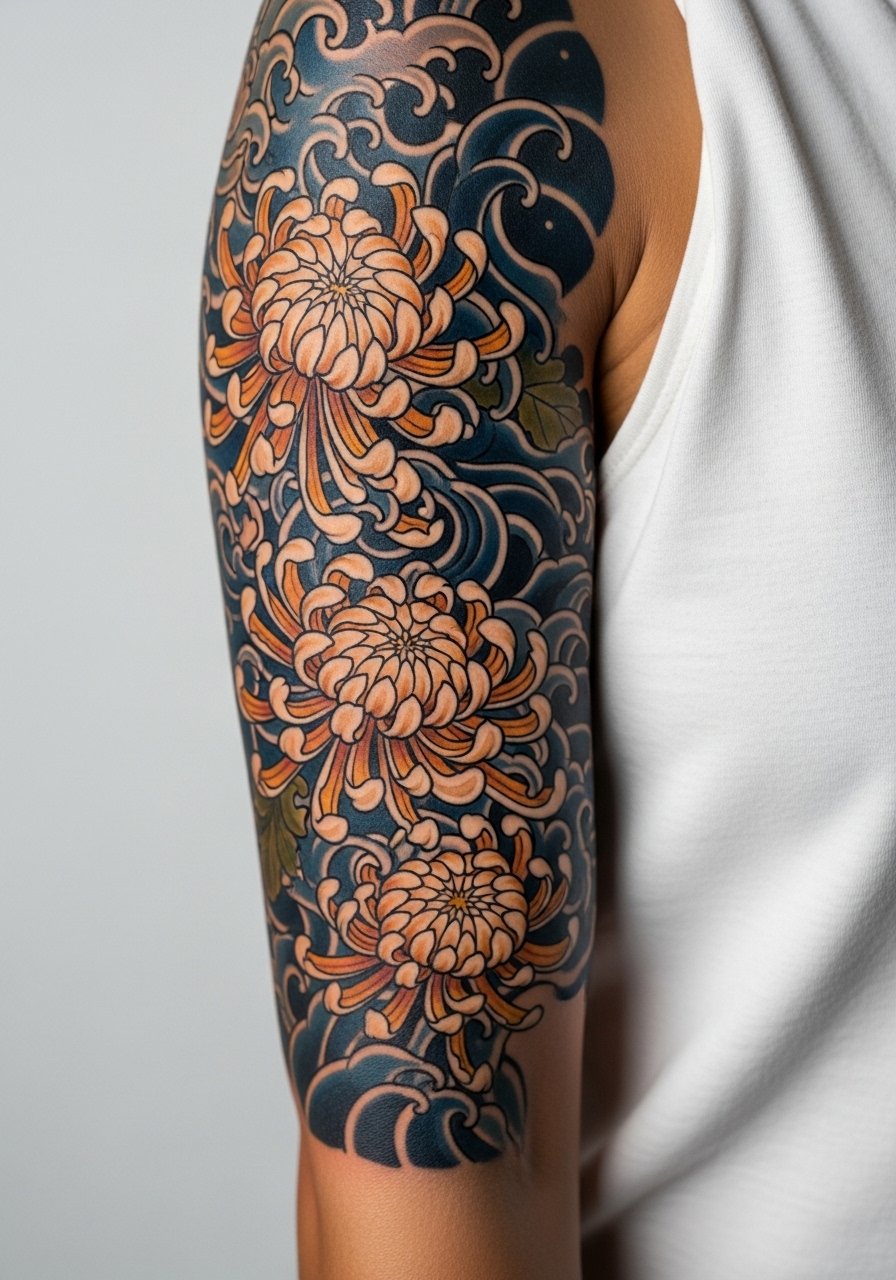
Chrysanthemums are classic in Japanese sleeves—they add volume and a formal floral rhythm. Paired with waves, they create a dynamic contrast between organic petals and geometric water patterns.
Style & Design Details
- Tattoo style: Traditional Japanese floral with bold negative space
- Recommended size: Quarter to full sleeve—chrysanthemum reads best large
- Best placements: Outer arm, shoulder to forearm wrap
- Color vs. blackwork: Color-dominant for petals with black water work
- Design elements: layered petals, curved wave bars, leaf negative space, bold outlines, delicate highlights
- Longevity note: large petals age gracefully if moisturized and sun-protected
- Who it suits: lovers of classic motifs and decorative sleeves
Finding the Right Artist
Look for floral compositions in healed photos. Ask how they’ll scale chrysanthemums so petals don’t blur together over time. An experienced Japanese-style artist is preferable.
Aftercare & Healing Tips
Avoid heavy friction on petal edges during peeling. Use Lubriderm or another fragrance-free lotion sparingly and apply sunscreen long-term when needed.
- Geisha Portrait Sleeve — Elegance and Portrait Realism
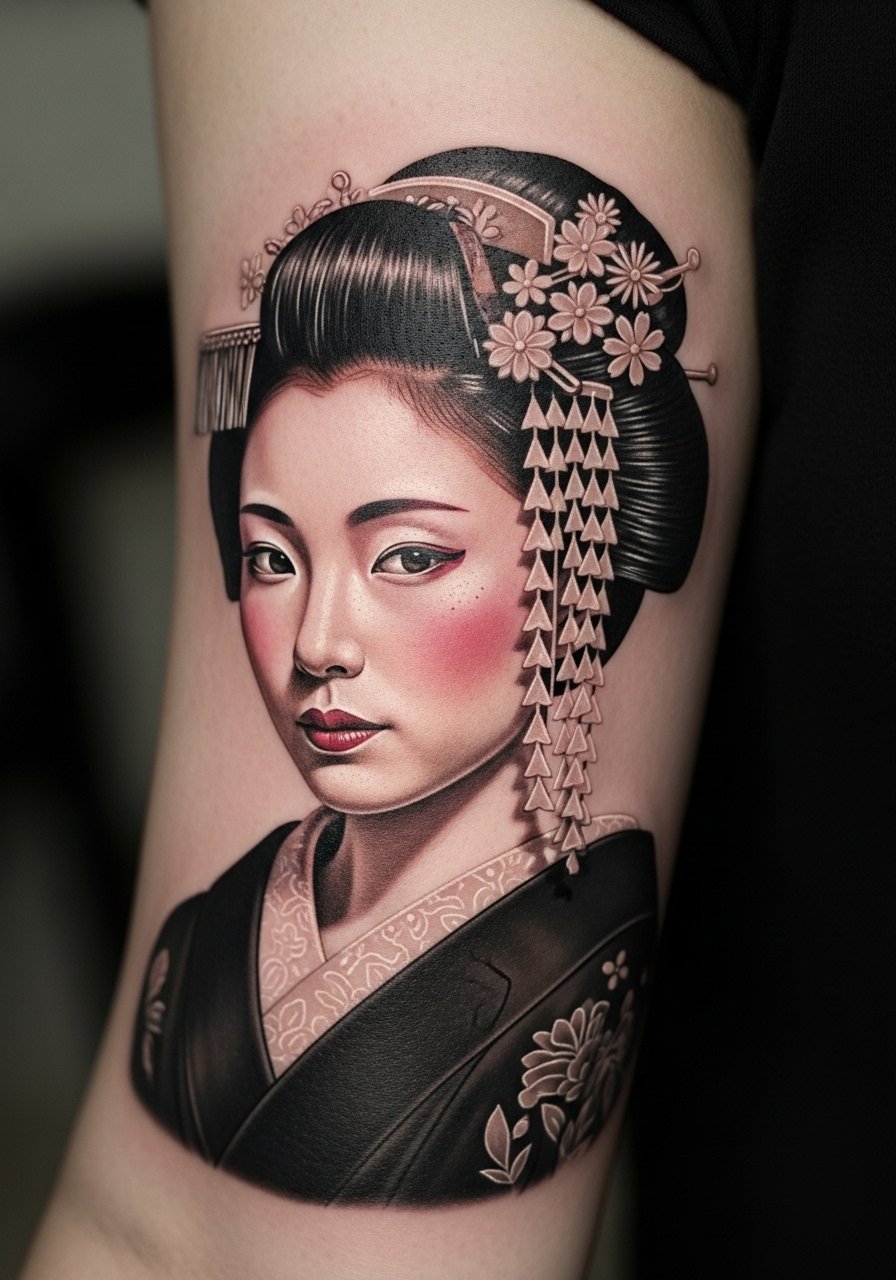
Geisha portraits require refined linework and portrait skills—facial proportions, soft shading, and kimono patterning. This style is for people who want elegant, human-centered imagery.
Style & Design Details
- Tattoo style: Illustrative portrait with Japanese motif
- Recommended size: Large (palm-sized or larger) to capture facial detail
- Best placements: Inner arm, upper arm, chest for portraits
- Color vs. blackwork: Soft color palette with charcoal linework
- Design elements: soft facial shading, hairpin detail, kimono patterning, negative space background, subtle highlights
- Longevity note: portraits need crisp lines and careful aging consideration; touch-ups may be needed for facial detail over time
- Who it suits: those seeking feminine, narrative portraiture
Finding the Right Artist
Only book artists with proven portrait work and healed photos. Ask about their approach to facial anatomy in tattoos and whether they use reference photos for custom design. Avoid artists who primarily do abstract or small-flash work.
Aftercare & Healing Tips
Portraits demand meticulous aftercare—gentle cleansing, thin lotion application, and no sun for several weeks. Keep hydrated and follow artist-specific product suggestions to retain soft shading.
- Full-Arm Map of Japanese Folklore — Episodic Story Sleeve
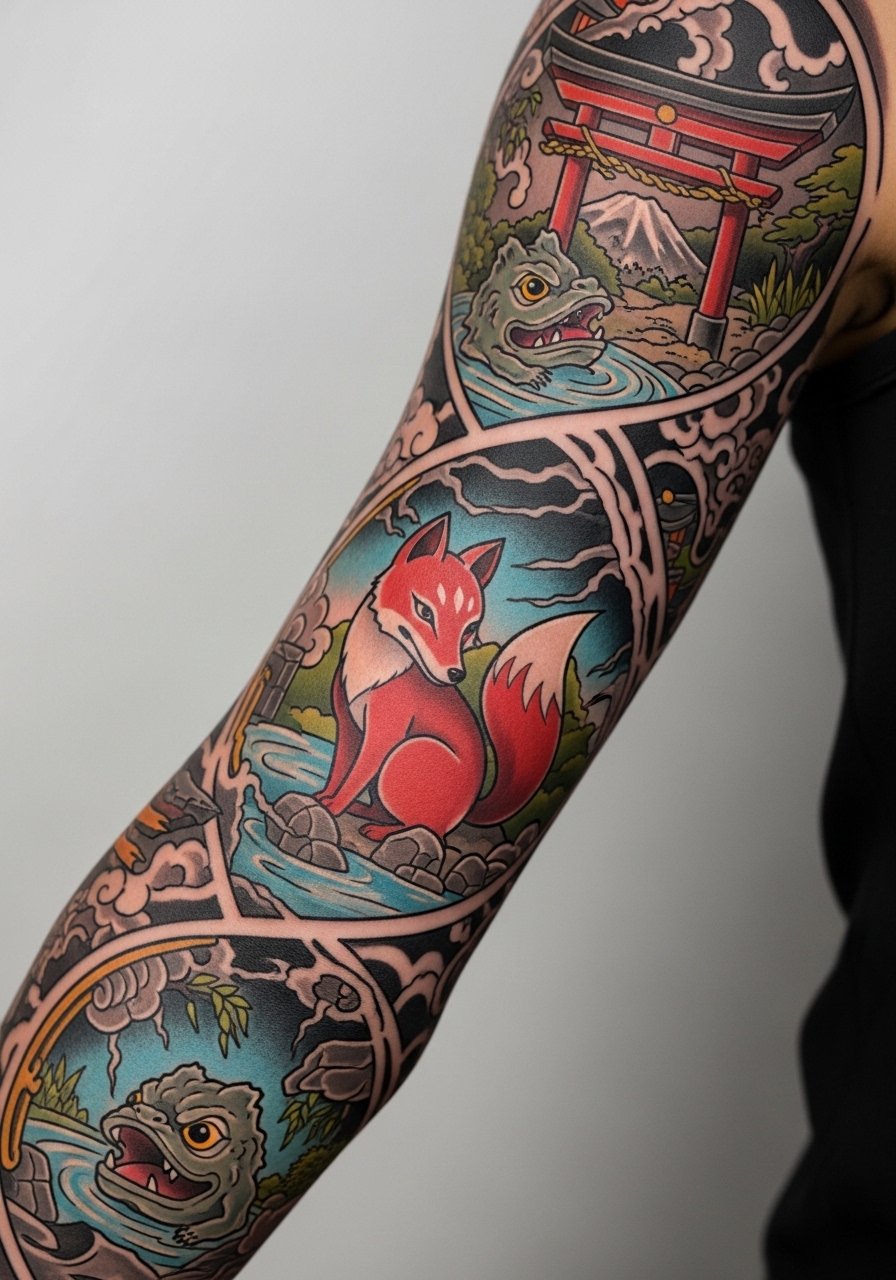
If you love stories, map several folklore scenes into episodic panels across the sleeve. This reads like a graphic novel and gives you variety while holding to a cohesive palette.
Style & Design Details
- Tattoo style: Illustrative narrative with multiple vignettes
- Recommended size: Full sleeve to make each vignette readable
- Best placements: Full arm or torso wrap for more panels
- Color vs. blackwork: Balanced palette—use color to differentiate scenes
- Design elements: panel borders, scene transitions, consistent wind bars, unified color scheme, small caption-free icons
- Longevity note: multiple small scenes mean more touch-ups over years for tiny details
- Who it suits: storytellers and collectors with patience for multiple sessions
Finding the Right Artist
Seek artists who specialize in narrative sleeves and can show sequence work. Discuss session breakdowns: artists often complete one vignette per session. Avoid anyone who rushes comping the sleeve in a single sitting.
Aftercare & Healing Tips
Each vignette will peel at different times—wash and moisturize gently, and be prepared for follow-up touch-ups after all panels heal. Use Saniderm early if you need protection over sensitive areas.
- Minimalist Irezumi Sleeve — Fine Line, Negative Space Focus
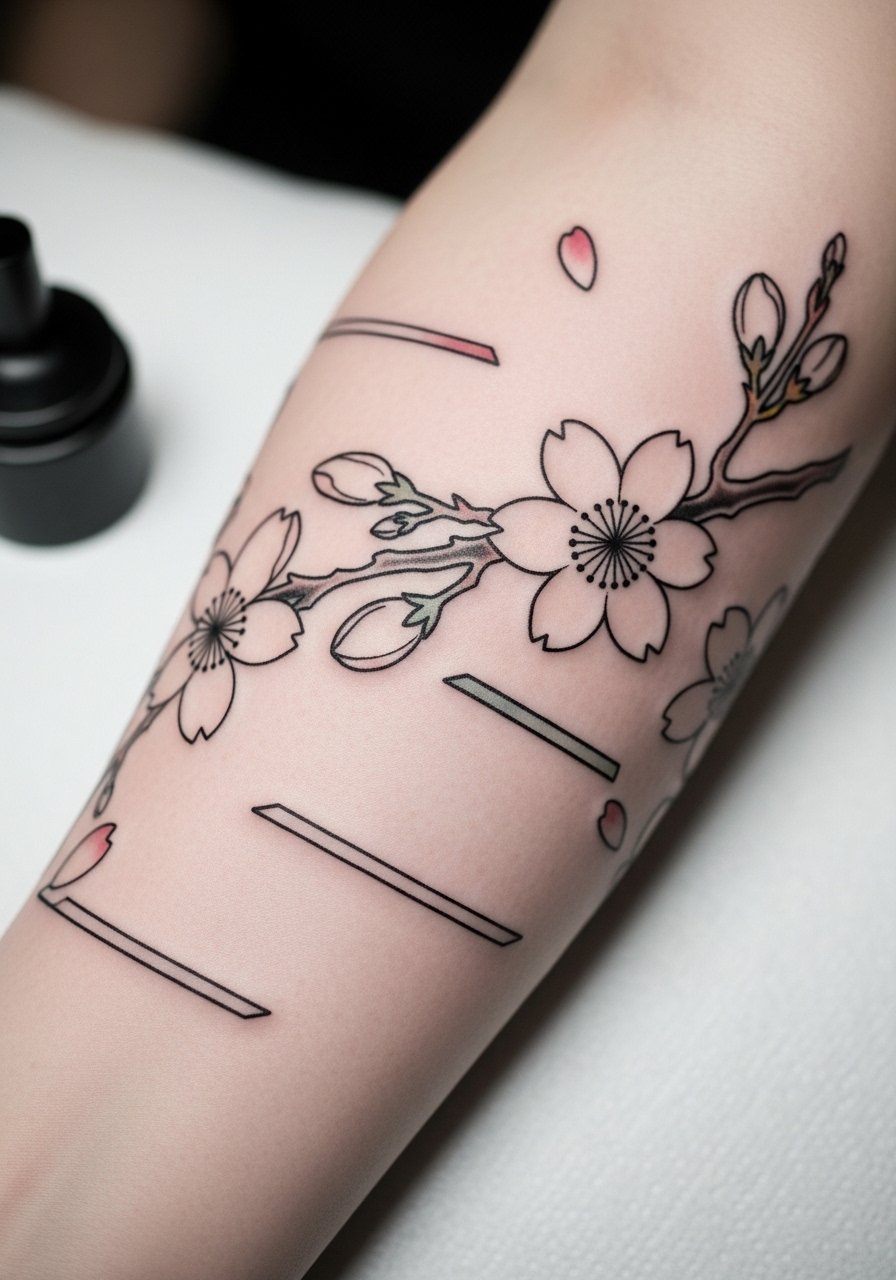
Want a sleeve that reads light and modern? Minimalist irezumi pares down motifs to outlines and strategic color accents, letting negative space do the heavy lifting.
Style & Design Details
- Tattoo style: Fine-line Japanese minimalism
- Recommended size: Quarter to half sleeve with spaced motifs
- Best placements: Forearm, inner arm, or wrist-to-elbow wrap
- Color vs. blackwork: Mostly black fine-line with small color pops
- Design elements: single-needle lines, open negative space, small sakura clusters, thin wind bars, delicate dotwork
- Longevity note: single-needle lines decay fastest—avoid high-friction areas for best longevity
- Who it suits: minimalists and those who want a sleeve that’s more subtle than full color
Finding the Right Artist
Only book artists with proven single-needle work and healed examples. Ask about needle types and whether they recommend bolder reworking for high-friction skin. Avoid artists who don’t show healed fine-line photos.
Aftercare & Healing Tips
Fine lines benefit from careful moisturizing and long-term SPF. Use an unscented lotion and expect delicate lines to need touch-ups in 1–3 years depending on placement.
- Oni and Bamboo Sleeve — Raw Energy with Delicate Bark
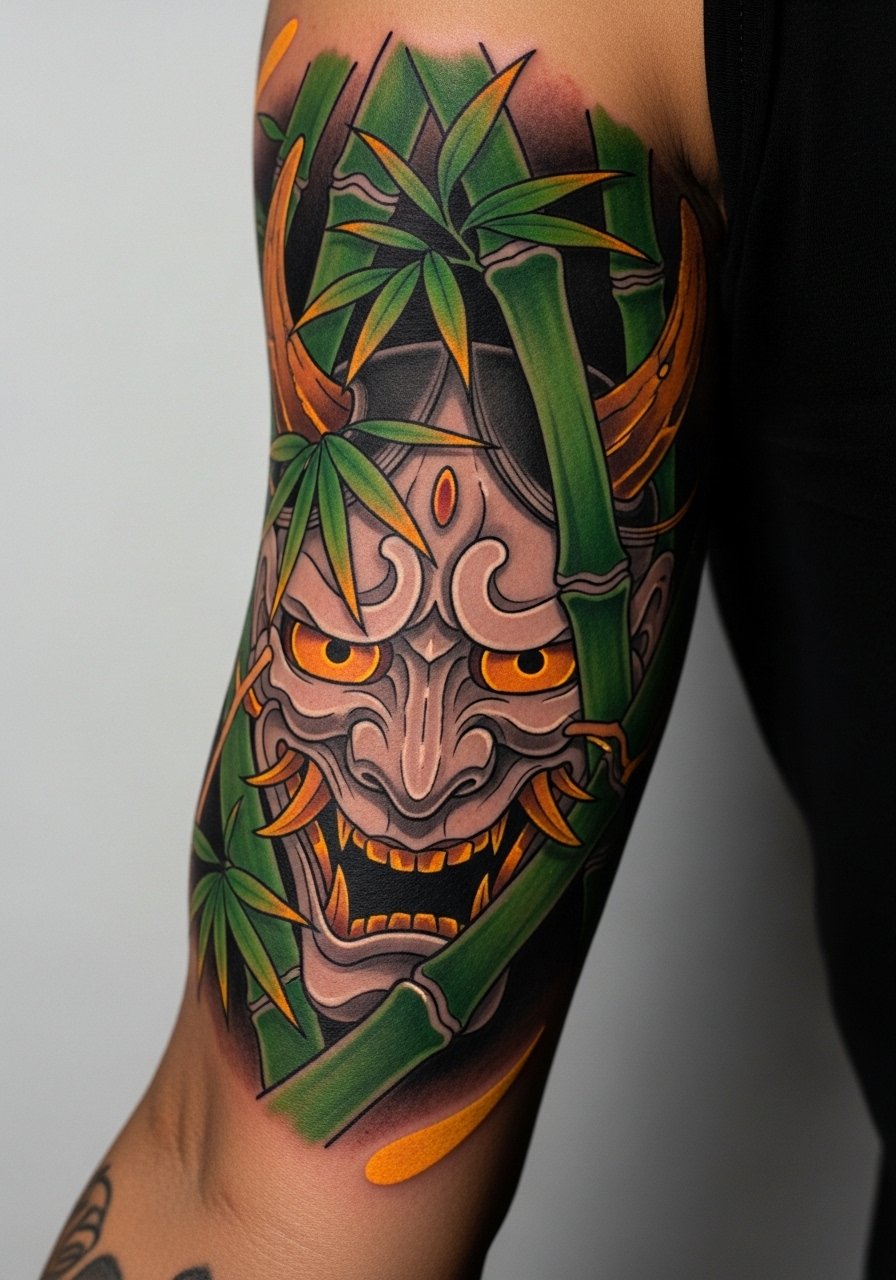
Pair an oni with bamboo to combine raw energy and calm structure. The straight bamboo stalks contrast the oni’s flowing mane, making a balanced, graphic composition.
Style & Design Details
- Tattoo style: Traditional Japanese with botanical framing
- Recommended size: Half-sleeve centered on the bicep or outer arm
- Best placements: Outer arm, shoulder cap, or integrated into chest pieces
- Color vs. blackwork: Black outlines with saturated greens and marigold highlights
- Design elements: bamboo nodes, mask teeth detail, leaf negative space, wind and water bars, stipple shading
- Longevity note: greens hold well with proper SPF; avoid repeated friction on stalks
- Who it suits: fans of contrast and bold mascots
Finding the Right Artist
Search for artists who demonstrate both botanical texture and mask shading. Ask about session order—typically masks first, botanical fill next.
Aftercare & Healing Tips
Bamboo leaves thin into small areas—moisturize lightly and avoid tight clothing rubbing during the first two weeks. Use fragrance-free soap and thin lotion layers.
- Koi-to-Dragon Transition Sleeve — Evolution of Motif
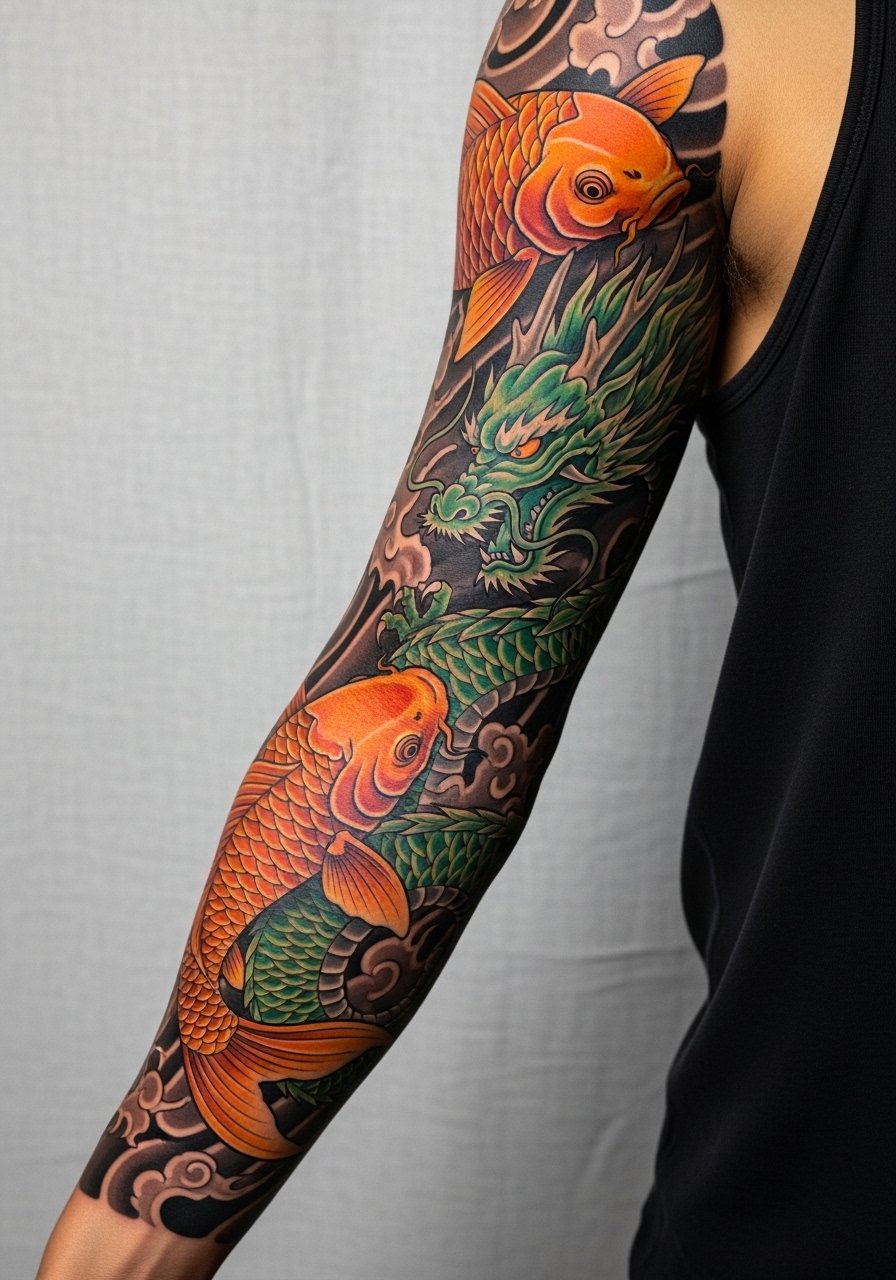
This idea dramatizes the koi legend: persistence becomes transformation. Start with koi at the wrist and slowly morph scalation and head shape into dragon form near the shoulder.
Style & Design Details
- Tattoo style: Narrative transformation irezumi
- Recommended size: Full sleeve for smooth visual morphing
- Best placements: Full arm to allow gradual evolution
- Color vs. blackwork: Color transition with sustained black outlines
- Design elements: scale gradation, transition wind bars, flowing fins to spines, gradient fills, cloud motifs
- Longevity note: gradients require careful shading to maintain flow; regular SPF helps colors keep their integrity
- Who it suits: narrative-minded collectors and myth lovers
Finding the Right Artist
Book an artist comfortable with complex transitions and scale detail. Request mockups showing the exact morphing points. Avoid artists unfamiliar with gradual color blending.
Aftercare & Healing Tips
Gradients can flake unevenly—keep moisturized and follow your artist’s wrap instructions closely. Expect a touch-up session to smooth transitions once fully healed.
- Blackwork Samurai Sleeve — Graphic Silhouettes and Texture
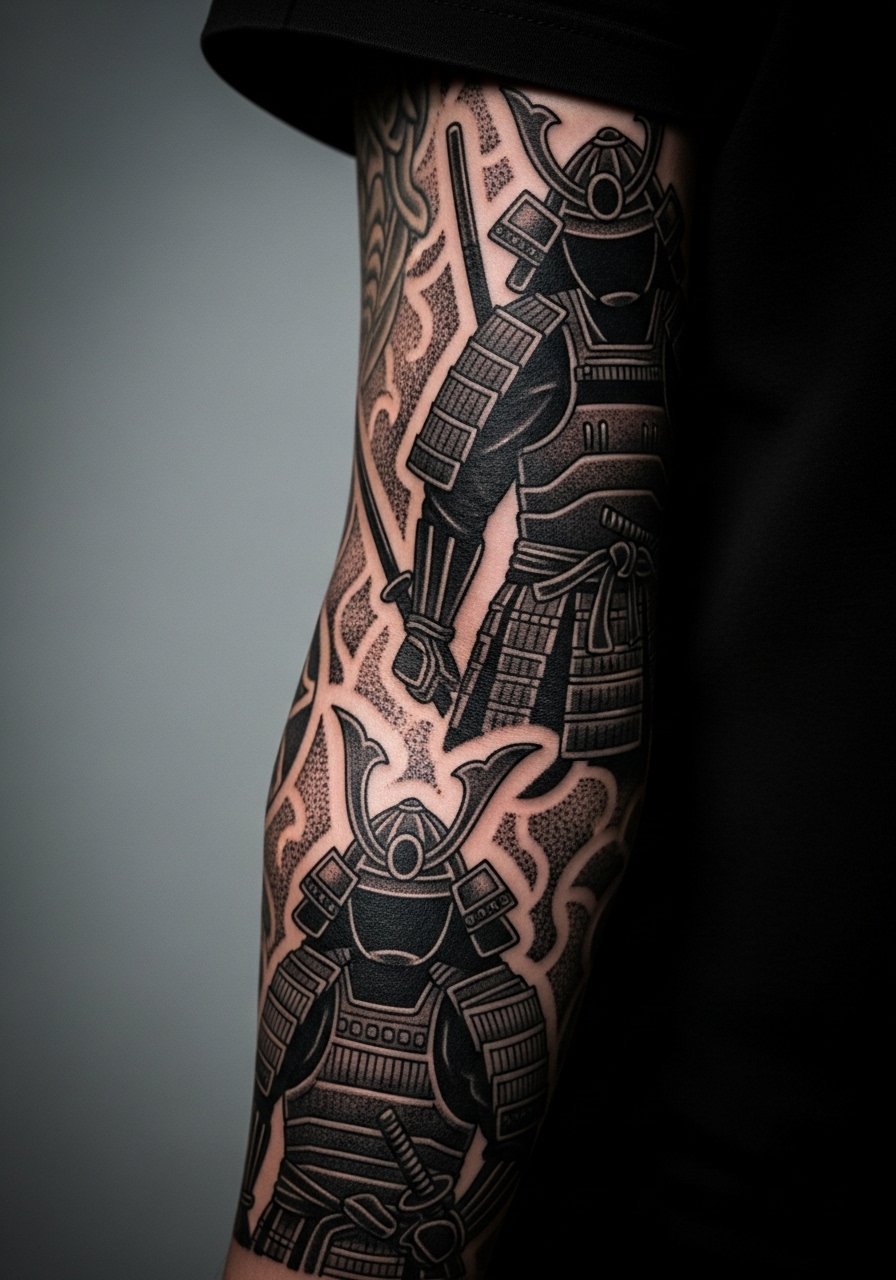
If you love stark contrast, a blackwork samurai sleeve emphasizes silhouette and negative space. Heavy black fills, stippling, and textured linework create a bold, graphic statement.
Style & Design Details
- Tattoo style: Blackwork with Japanese motifs
- Recommended size: Half to full sleeve depending on coverage
- Best placements: Outer arm, full sleeve, or chest wrap for larger blackfields
- Color vs. blackwork: 100% blackwork
- Design elements: solid fills, negative-space highlights, stippling, bold silhouettes, wind bars in negative space
- Longevity note: black holds very well; large black areas can cause skin textural changes over time
- Who it suits: lovers of graphic design and bold sleeve contrast
Finding the Right Artist
Choose artists who do large-scale blackwork and healed examples of dense blackfields. Ask how they prevent excessive scarring under heavy fill sessions. An experienced blackwork tattooer is preferred.
Aftercare & Healing Tips
Large blackfields produce heavy scabbing—avoid over-moisturizing and keep sessions spaced to allow skin recovery. Follow artist guidance for wrap timing and moisturizing to prevent saturation issues.
- Watercolor Koi Sleeve — Painterly Washes with Japanese Motifs
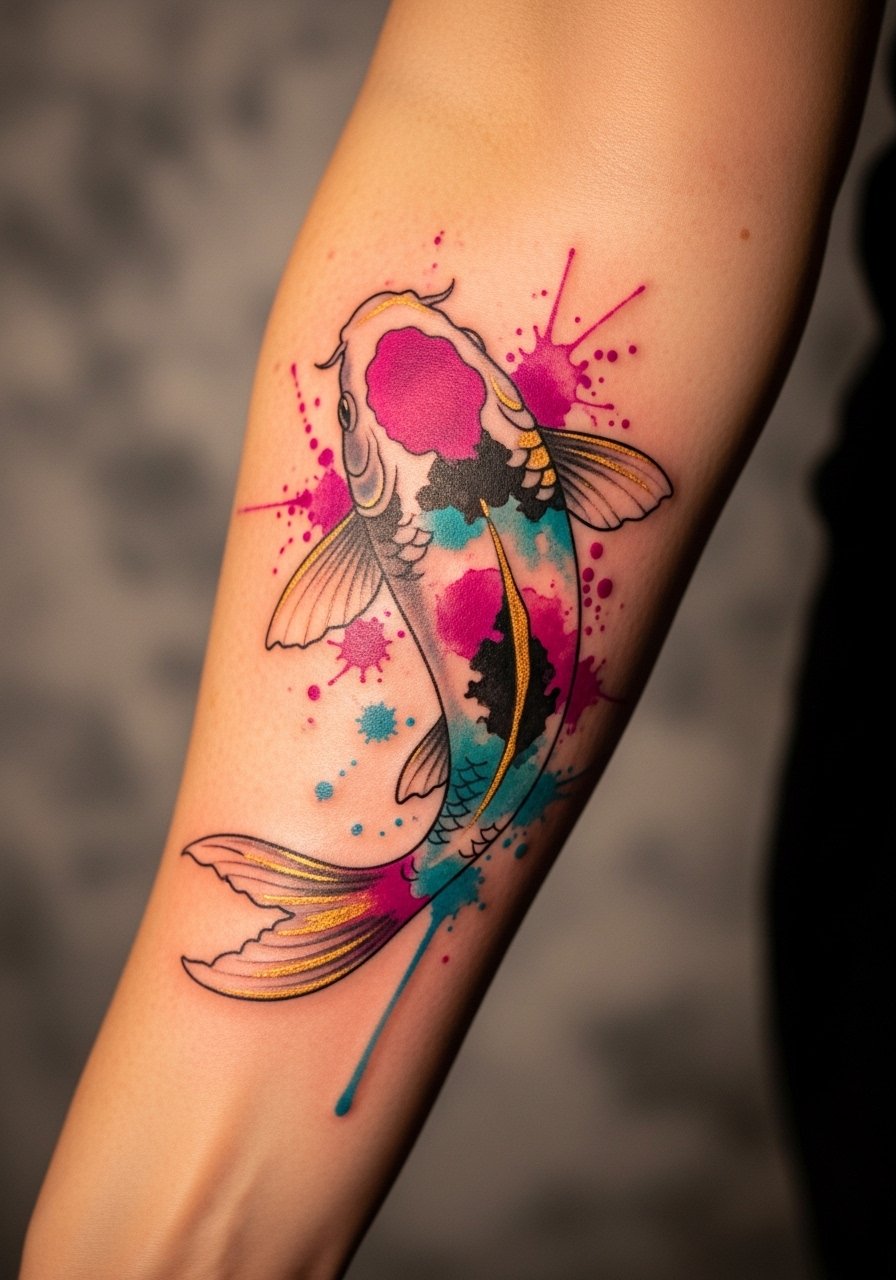
Watercolor techniques applied to Japanese motifs create soft, painterly sleeves without hard backgrounds. Expect more bleeding color transitions and an airy feel.
Style & Design Details
- Tattoo style: Watercolor-tinged Japanese illustrative
- Recommended size: Half to full sleeve to allow wash areas
- Best placements: Forearm, outer arm—areas with lower friction
- Color vs. blackwork: Color-dominant with occasional thin black anchors
- Design elements: soft color washes, splatter effects, faint outlines, negative space, subtle highlights
- Longevity note: watercolor fades faster—SPF and touch-ups are crucial for longevity
- Who it suits: those wanting a softer, painterly sleeve
Finding the Right Artist
Only book artists with a portfolio in watercolor tattoos; ask for healed photos since fresh watercolor looks different healed. Avoid artists who only do traditional solid fills.
Aftercare & Healing Tips
Watercolor heals unevenly—moisturize gently and avoid heavy friction. After healing, use color-enhancing balms or schedule color refresh sessions.
- Snake and Peony Wrap — Sensual Curves and Floral Contrast
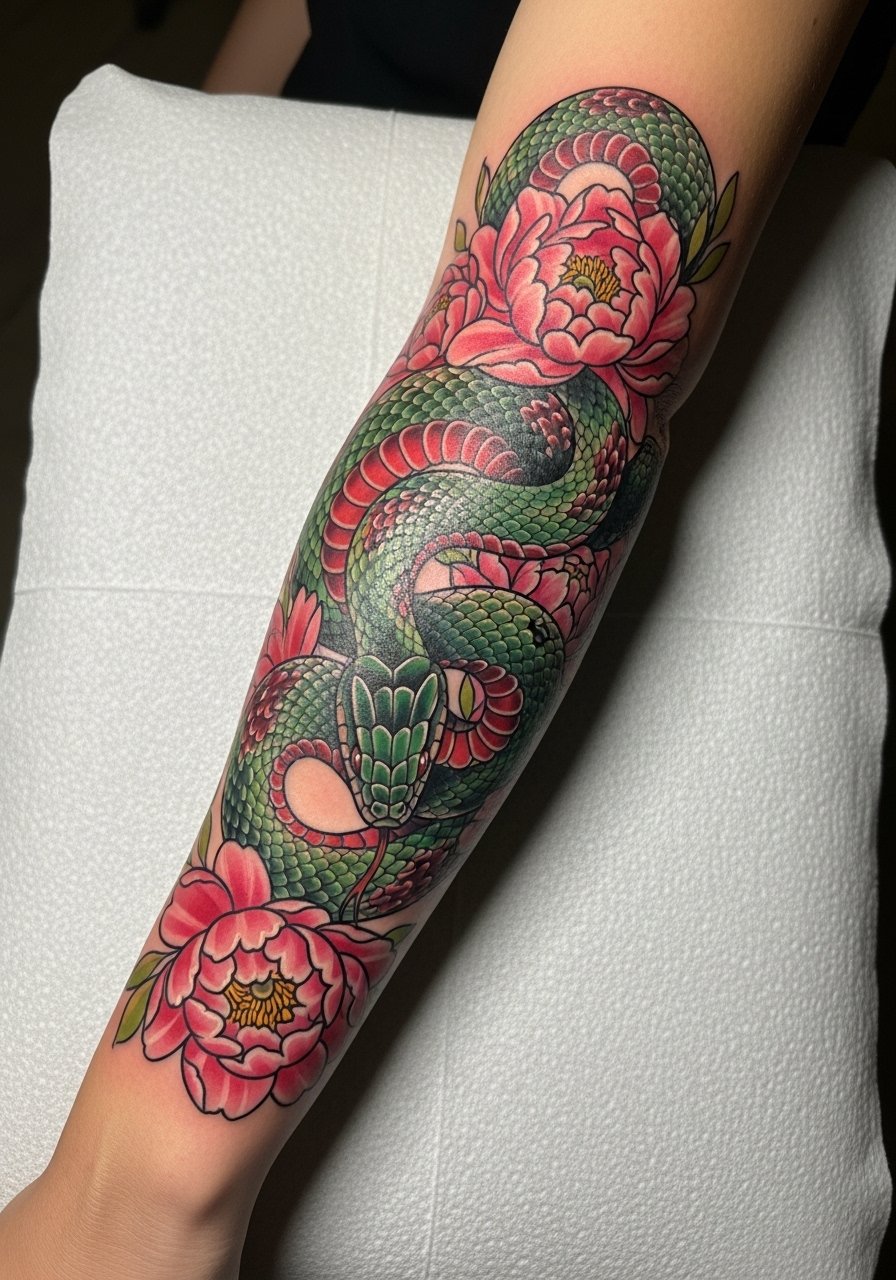
A snake weaving through peonies balances toughness with softness. Scale detail, glossy highlights, and layered petals make this a tactile sleeve that catches light.
Style & Design Details
- Tattoo style: Traditional Japanese with realistic texture
- Recommended size: Half to full sleeve for coil readability
- Best placements: Full arm, forearm wrap, or bicep-centered
- Color vs. blackwork: Color-forward with reflective highlights
- Design elements: scale texture, peony layers, reflective white highlights, shadowed coil overlaps, wind bars
- Longevity note: highlights can fade but core colors hold if sun-protected
- Who it suits: those seeking sensual, tactile composition
Finding the Right Artist
Seek artists who do realistic scale work and floral layering. Ask about highlight placement and how they plan to prevent blowout at scale junctions. An experienced tattooer with texture work is best.
Aftercare & Healing Tips
Keep coils dry and gently moisturized—avoid tight sleeves that compress scales during the first week. Consider a touch-up once everything fully settles.
- Moonlit Fox (Kitsune) Sleeve — Ethereal Light and Pattern
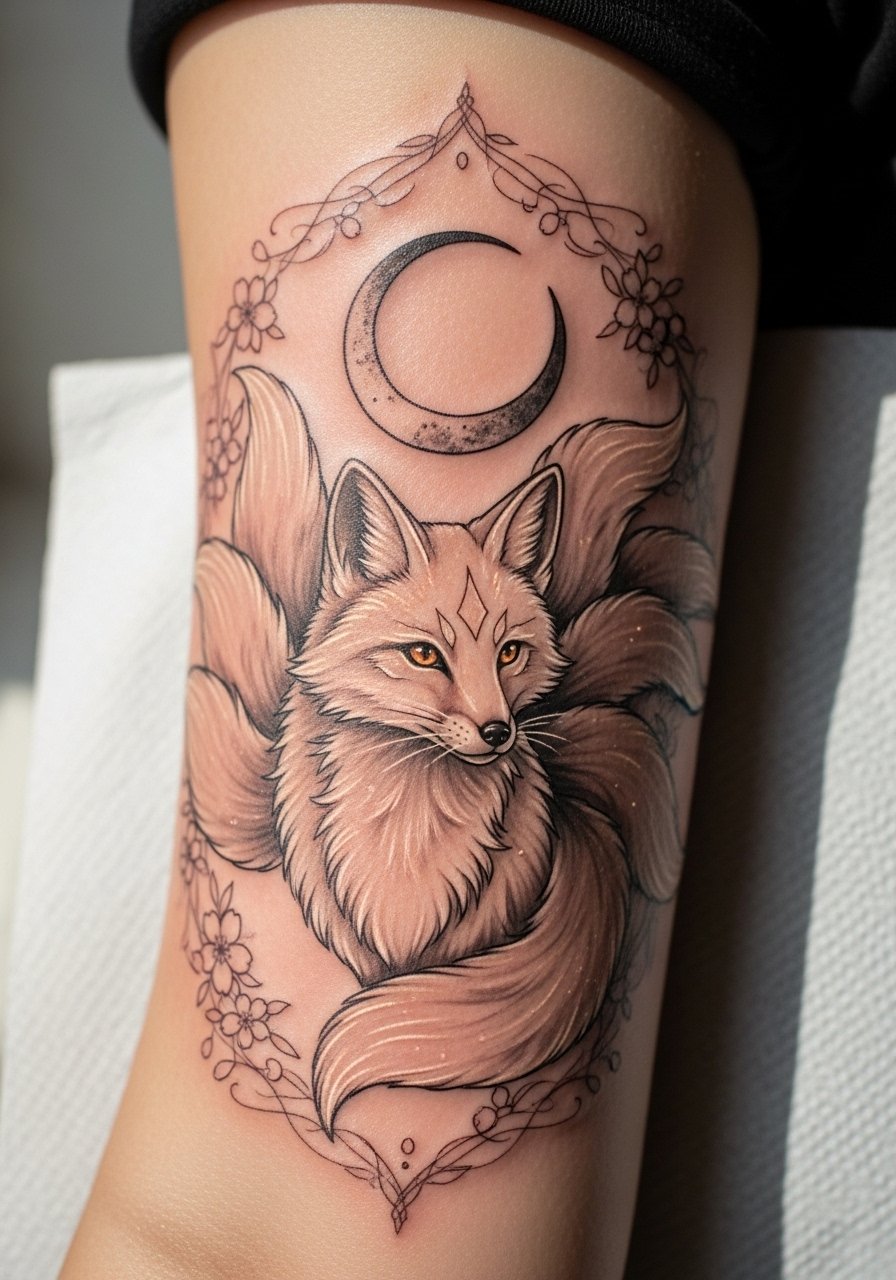
Kitsune tattoos mix mischief and mystique—use moonlight highlights and faint glowing eyes to create an ethereal sleeve that reads at night and day.
Style & Design Details
- Tattoo style: Illustrative mystical irezumi
- Recommended size: Half sleeve centered on inner arm or forearm
- Best placements: Inner arm, ribcage, or upper arm for intimate viewing
- Color vs. blackwork: Soft color glows with black anchors
- Design elements: luminous highlights, nine-tail suggestion, floral border, subtle dotwork, negative-space moon
- Longevity note: glow highlights may fade faster; long-term SPF helps maintain contrast
- Who it suits: lovers of folklore with a preference for softer palettes
Finding the Right Artist
Choose artists experienced with luminous effects and subtle highlights. Ask for healed photos showing glow work over time. An illustrative or neo-traditional artist who understands shading is ideal.
Aftercare & Healing Tips
Glows and delicate highlights need careful moisturizing and sun avoidance. Use a light, unscented lotion to maintain subtle contrast during peeling.
- Crane and Pine Sleeve — Longevity Motif with Elegant Lines
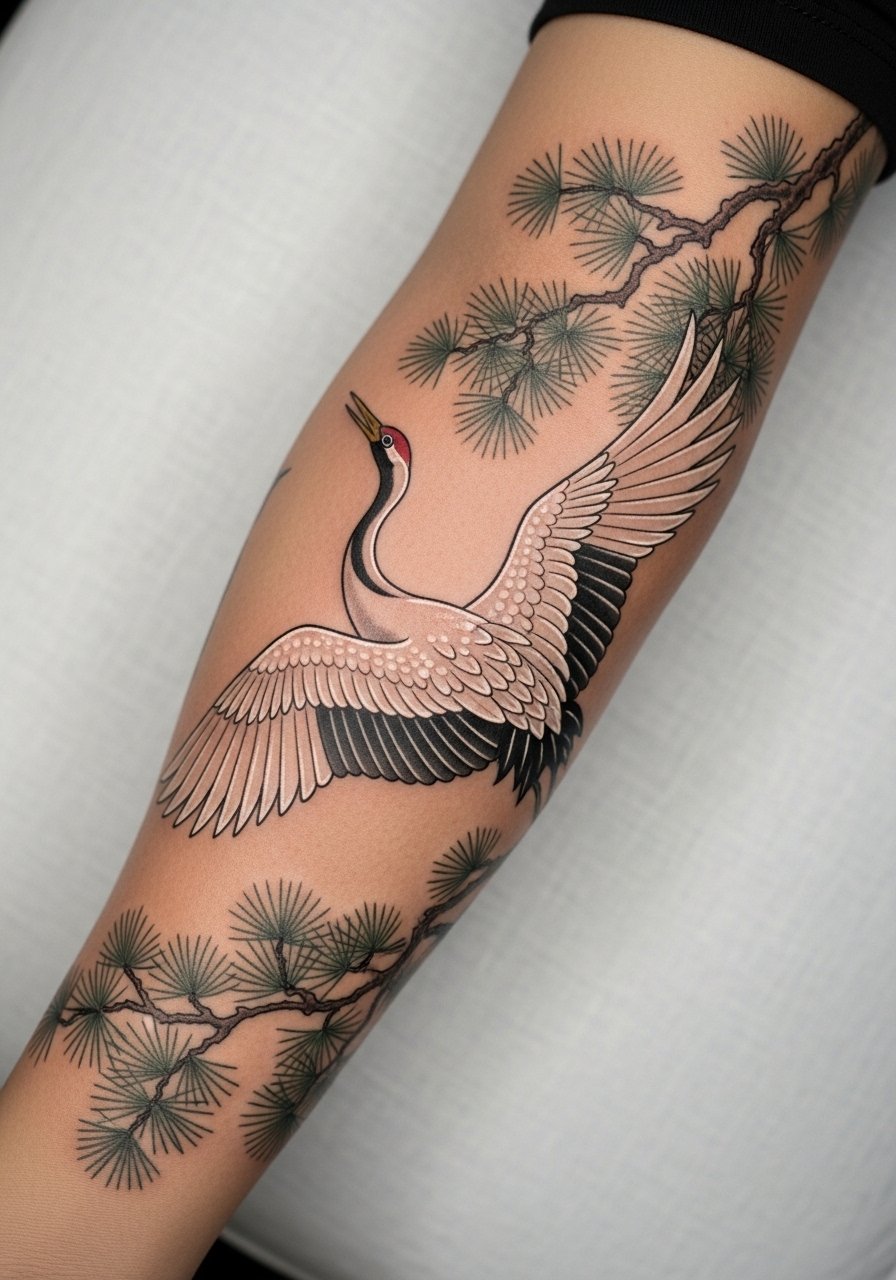
Cranes and pines symbolize longevity and good fortune. This design uses elegant negative-space wings and textured pine bark to create an uplifted, serene sleeve.
Style & Design Details
- Tattoo style: Traditional Japanese with elegant naturalism
- Recommended size: Half to full sleeve with cranes sized prominently
- Best placements: Outer arm, shoulder cap, upper arm for flight motion
- Color vs. blackwork: Mostly black and green with white highlights
- Design elements: wing negative space, pine needle texture, distant mountain suggestion, soft cloud bars, subtle highlights
- Longevity note: whites can yellow over time; touch-ups keep crisp edges
- Who it suits: those who want a refined, symbolic sleeve
Finding the Right Artist
Pick an artist adept at feather negative-space work and botanical texture. Ask about white ink usage and how they prevent yellowing.
Aftercare & Healing Tips
White highlights require careful sun protection. Use SPF regularly and keep the area moisturized during healing.
- Tempest Sleeve — Storm Waves and Lightning Bars
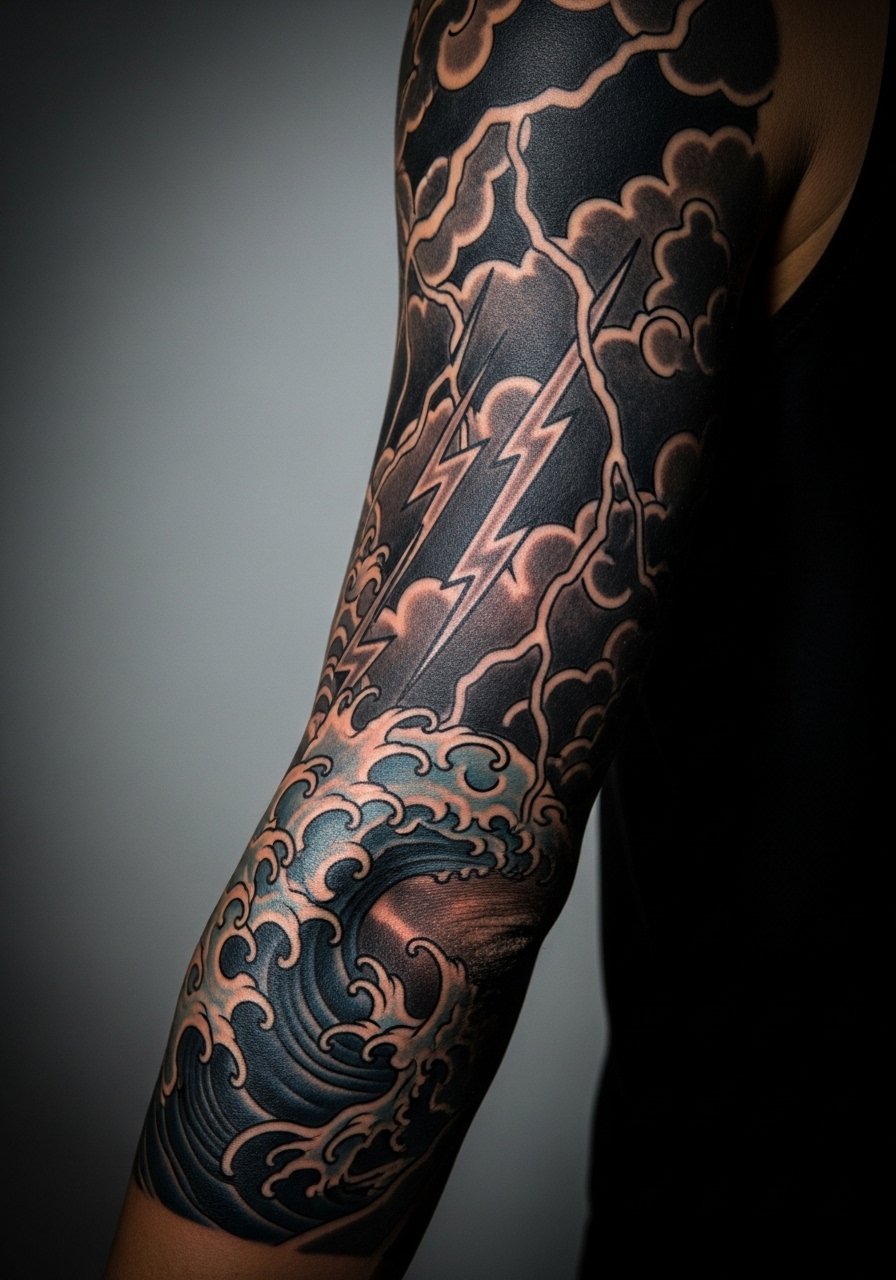
Channel raw weather with crashing waves and lightning—this sleeve is graphic and intense, using bold contrasts and white highlights for flash.
Style & Design Details
- Tattoo style: Traditional Japanese storm motifs with graphic blackwork
- Recommended size: Half to full sleeve depending on desired intensity
- Best placements: Full arm or back wrap for large storm scenes
- Color vs. blackwork: Predominantly black/grey with white highlights
- Design elements: aggressive linework, white flash highlights, layered waves, lightning bars, dense cloud fields
- Longevity note: heavy black areas age well, white highlights may need refreshing
- Who it suits: people who want a bold, dramatic look
Finding the Right Artist
Hire an artist who executes heavy black and white flash well. Ask for healed images of large blackfields. Avoid artists inexperienced with dense blackwork.
Aftercare & Healing Tips
Large blackfields produce heavy scabbing—follow your artist’s instructions for healing intervals and moisturizing carefully to avoid scab removal.
- Samurai & Cherry Blossom Sleeve — Honor and Fleeting Beauty
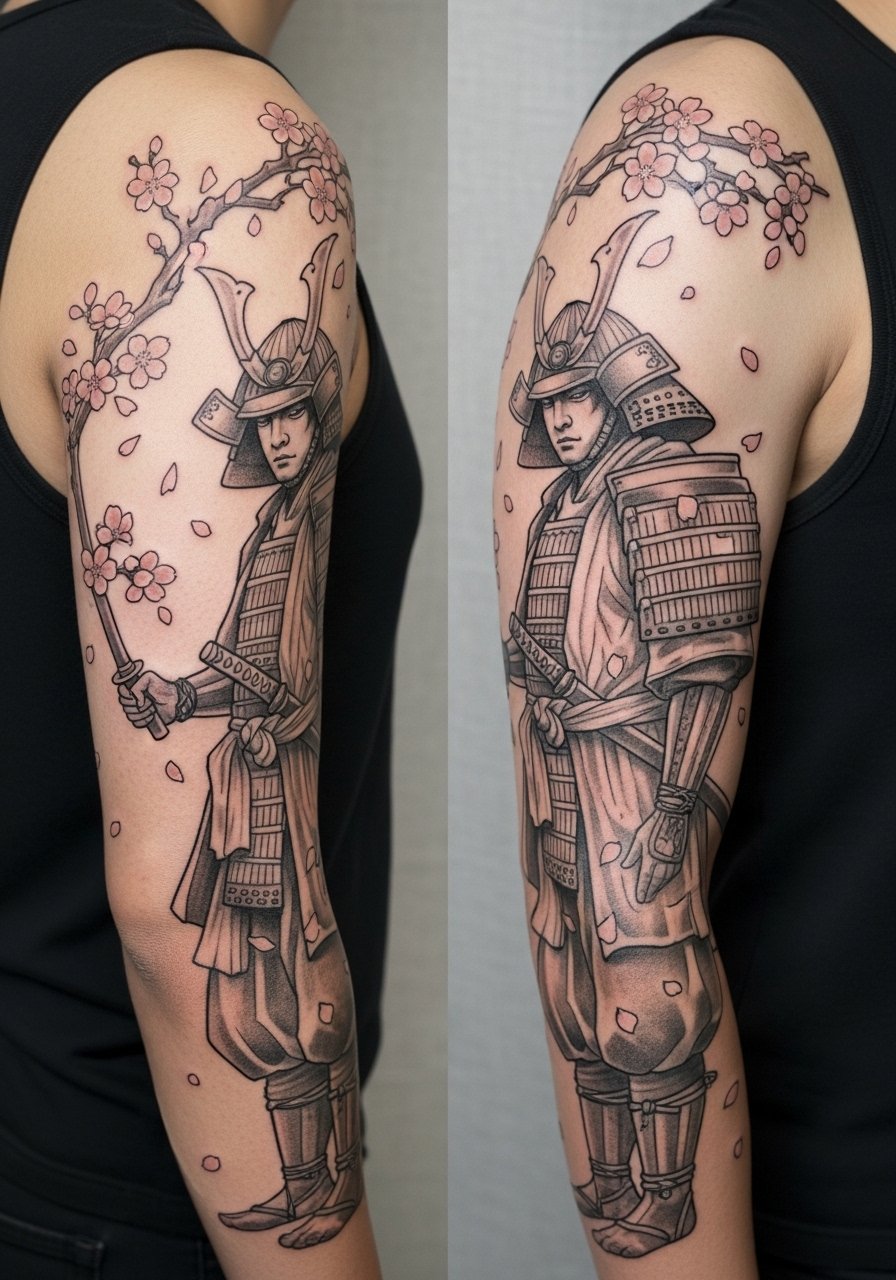
This pairing juxtaposes the stoic samurai with ephemeral sakura petals. Use soft pinks against charcoal armor to highlight fleetingness alongside honor.
Style & Design Details
- Tattoo style: Traditional narrative with floral accenting
- Recommended size: Half sleeve focused on upper arm
- Best placements: Outer arm or shoulder cap
- Color vs. blackwork: Black-dominant with blush cherry blossoms
- Design elements: armor detail, falling sakura, soft petal shading, wind bars, negative space foreground
- Longevity note: small blush petals fade faster; larger dark areas last longest
- Who it suits: fans of classic symbolism and contemplative narratives
Finding the Right Artist
Look for samurai scenes and floral pairing in portfolios. Ask about petal spacing to avoid muddiness over time.
Aftercare & Healing Tips
Petals often crust—moisturize lightly and avoid rubbing. Use SPF long-term on blossoms to reduce fading.
- Mountain Shrine Sleeve — Quiet Architecture and Scenic Panels
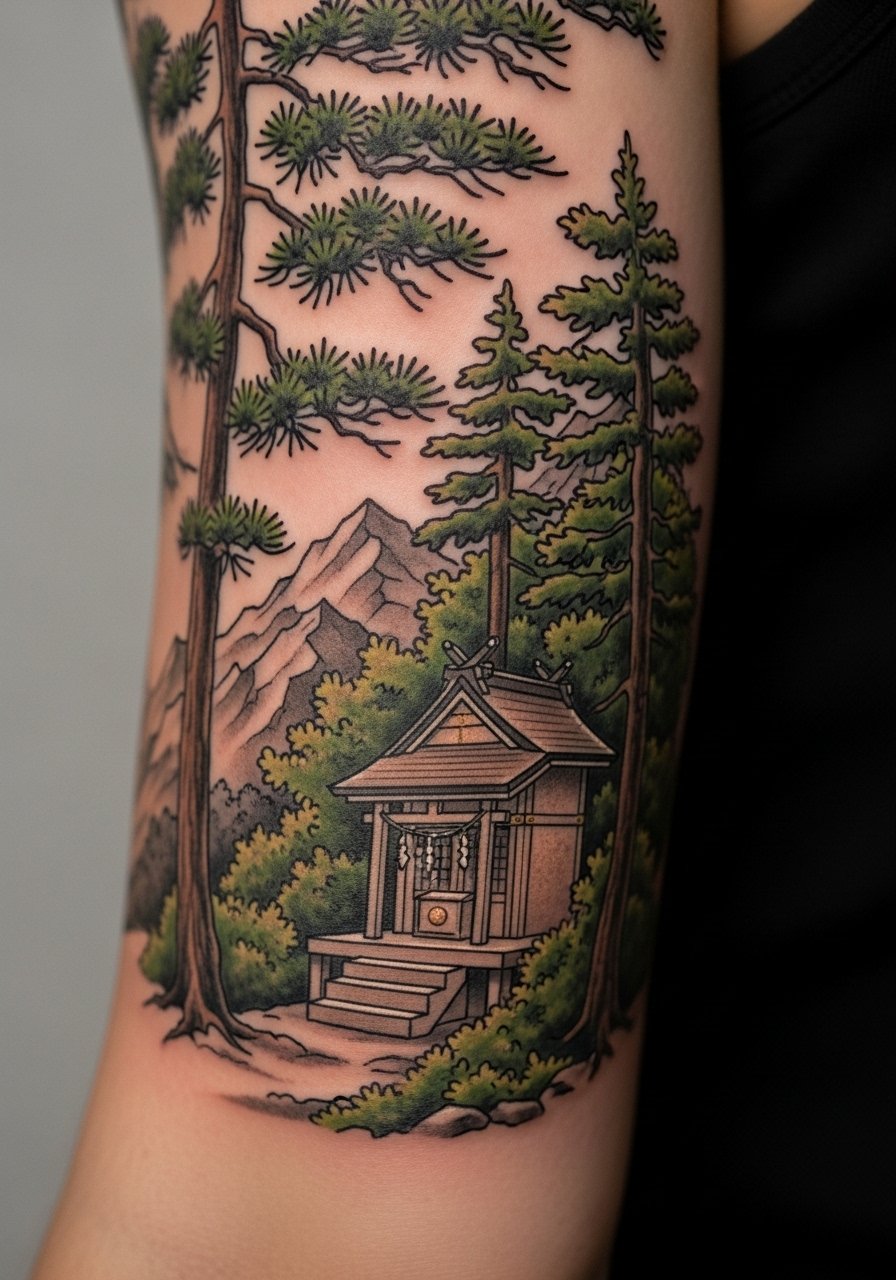
A shrine scene brings architectural lines into the sleeve, balancing natural motifs with hard structure. This works well for a thoughtful, scenic sleeve.
Style & Design Details
- Tattoo style: Japanese landscape illustration
- Recommended size: Half to full sleeve for scenic depth
- Best placements: Full arm or back wrap
- Color vs. blackwork: Earth tone palette with black anchors
- Design elements: shrine architecture, layered mountains, pine textures, fog negative space, tiny figure details for scale
- Longevity note: landscapes age well if large shapes are prioritized over tiny details
- Who it suits: lovers of travel, quiet scenery, and contemplative pieces
Finding the Right Artist
Seek artists with landscape or scenic portfolios. Ask how they’ll maintain depth and prevent small-detail decay.
Aftercare & Healing Tips
Large scenic pieces need gradual session pacing; follow wound care and moisturizing guidance. Expect minimal touch-ups if large shapes are prioritized.
- Floral Mandala and Koi Sleeve — Decorative Symmetry
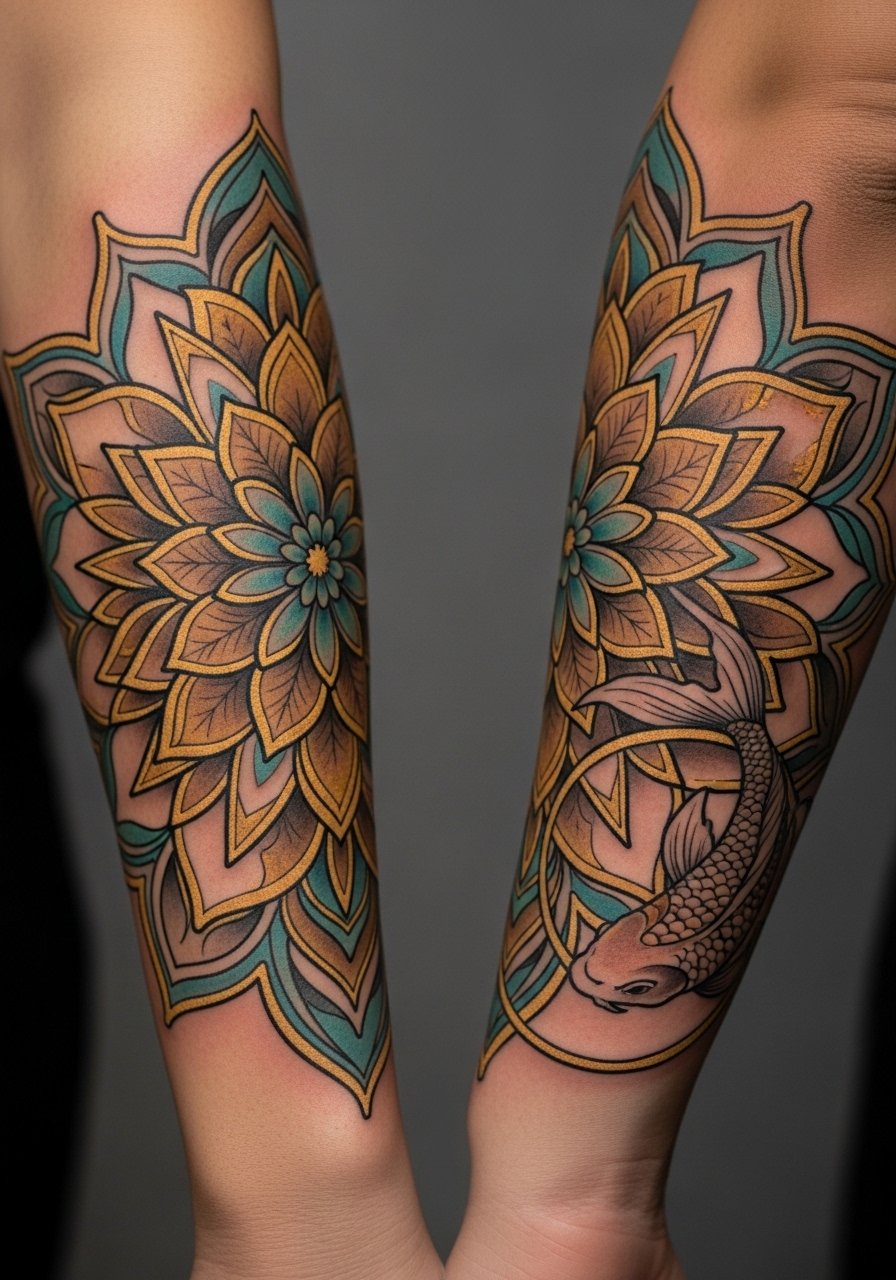
Combine mandala symmetry with Japanese flora and a koi orbiting the core to build a decorative, balanced sleeve with rhythmic repetition.
Style & Design Details
- Tattoo style: Decorative fusion—mandala + Japanese elements
- Recommended size: Quarter to half sleeve centered on forearm
- Best placements: Forearm, outer arm for display
- Color vs. blackwork: Balanced color with black detailing
- Design elements: symmetry, repetitive petals, koi orbit, dotwork fills, line mandalas
- Longevity note: dotwork may blur slightly—keep moisturized and avoid friction
- Who it suits: symmetry lovers and ornamental aesthetic fans
Finding the Right Artist
Find someone who does mandalas and illustrative koi. Ask about symmetry checks during stencil placement and stained glass-like fills.
Aftercare & Healing Tips
Mandala edges should remain crisp—follow standard washing and thin lotion application. Avoid heavy rubbing during early healing.
- Storm Cloud Dragon Sleeve — Moody Monochrome Motion

A monochrome dragon with cloudwork evokes dramatic motion with a refined palette. Heavy shading and texture replace color with depth.
Style & Design Details
- Tattoo style: Black and grey Japanese realism
- Recommended size: Half to full sleeve for full motion
- Best placements: Full arm or outer bicep
- Color vs. blackwork: Monochrome black/grey with white highlights
- Design elements: deep shading, cloud texture, scale detail, high-contrast highlights, stippling
- Longevity note: monochrome is durable; textured shading can retain detail longer than thin color lines
- Who it suits: those who prefer mood and restraint over color
Finding the Right Artist
Seek black-and-grey specialists with dragon portfolios. Ask about their approach to layering darks and highlights.
Aftercare & Healing Tips
Large shaded areas produce more scabbing—space sessions out and follow aftercare for heavy fills. Use unscented lotion to manage tightness during peeling.
- Maple Leaf and Armor Sleeve — Autumnal Palette with Geometric Armor
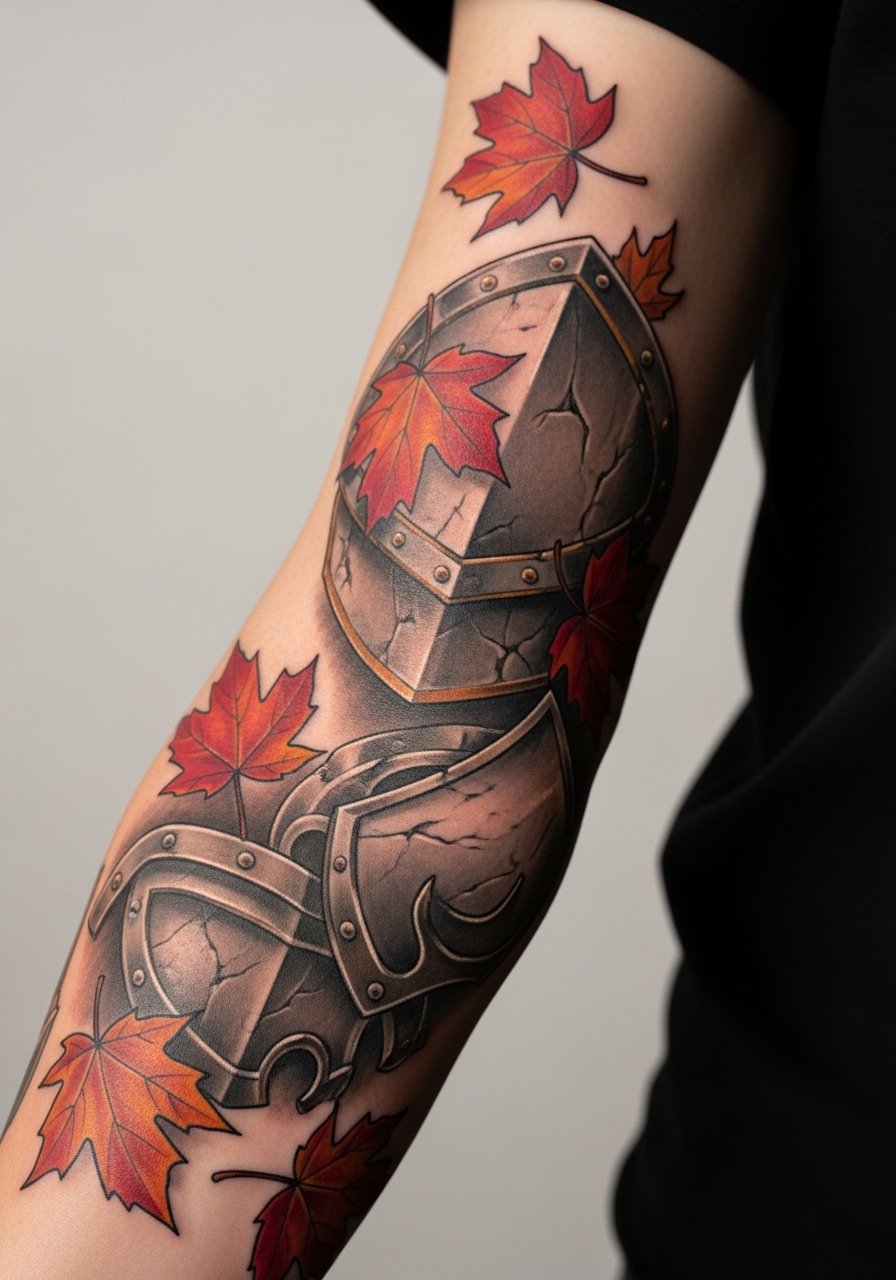
Autumnal hues paired with armor plates create a seasonal sleeve with geometric repeat and organic overlay. Leaves give directionality while armor provides structure.
Style & Design Details
- Tattoo style: Traditional Japanese with geometric armor patterning
- Recommended size: Half to full sleeve to allow leaf movement
- Best placements: Outer arm, upper arm, shoulder blend
- Color vs. blackwork: Warm autumn palette with black anchors
- Design elements: maple leaves, plate textures, rivet dots, negative space veins, soft gradients
- Longevity note: reds and oranges need SPF to keep brightness; armor blacks last longer
- Who it suits: seasonal aesthetic lovers and structure-oriented designs
Finding the Right Artist
Choose artists who mix natural and geometric textures. Ask how they’ll prevent small leaf details from merging as they age.
Aftercare & Healing Tips
Leaves can crust—moisturize lightly and avoid picking. Use SPF for reds and schedule a refinement session if edges soften.
- Inkbox-Tested Placement Sleeve — Try Before You Commit
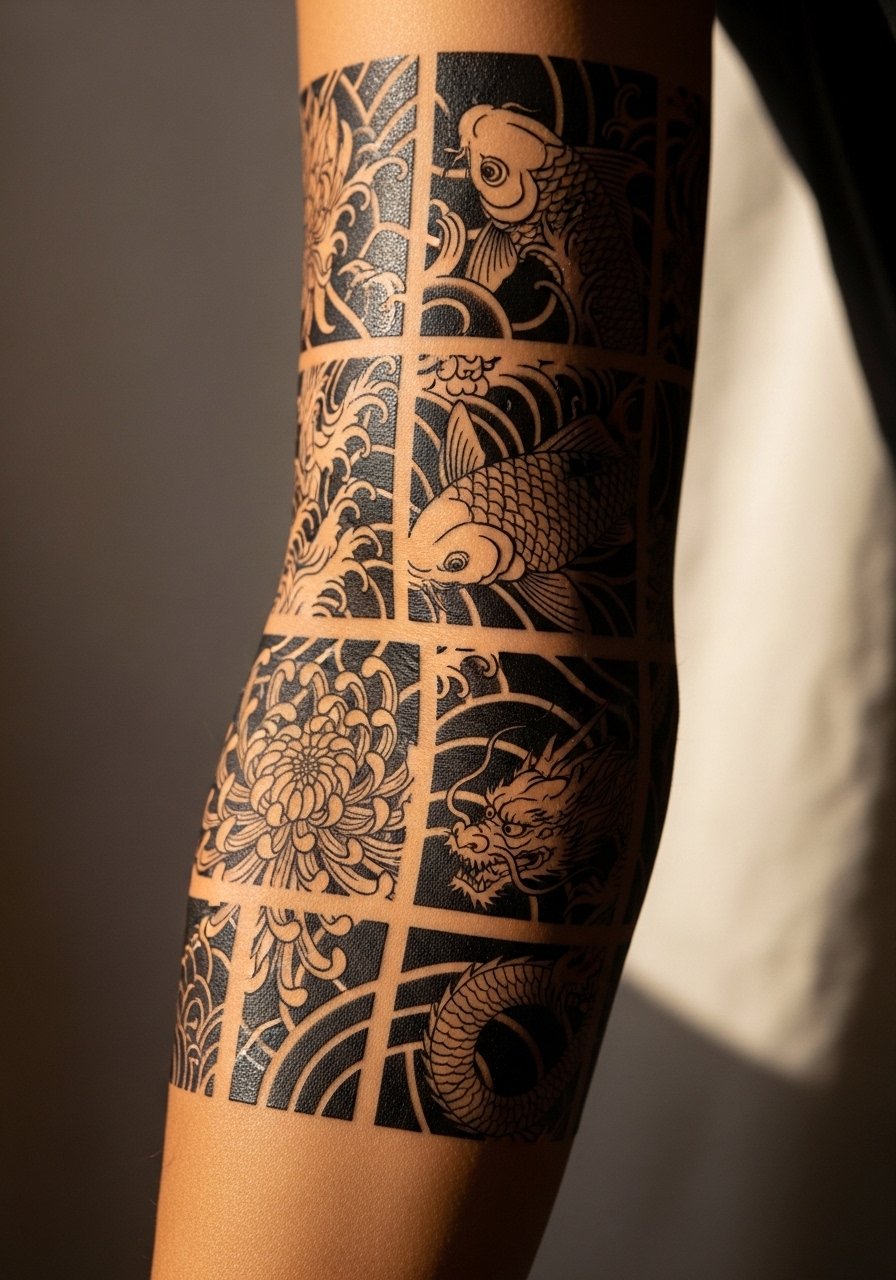
If you’re unsure about commitment, lay out a temporary sleeve with semi-permanent tests like Inkbox or stencil transfer paper. This helps refine placement, scale, and whether a full sleeve fits your daily life.
Style & Design Details
- Tattoo style: Testing/stencil stage for any Japanese sleeve
- Recommended size: N/A—helps decide eventual sleeve size
- Best placements: Try full arm wraps or segmented placements to test mobility
- Color vs. blackwork: Use black Inkbox for placement testing; color can be mock-tested with diluted inks or stickers
- Design elements: test scale, flow, elbow wraps, negative space decisions, sleeve entry points
- Longevity note: Inkbox lasts up to two weeks—great for seeing how a sleeve wears in clothes and movement
- Who it suits: hesitant committers, first-timers, anyone testing workwear compatibility
Finding the Right Artist
Bring your temporary test photos to the consult. Artists appreciate seeing how a design read on your arm in motion. Consider booking short consult sessions to iterate on composition.
Aftercare & Healing Tips
If you commit after testing, follow a standard aftercare routine: gentle washing, thin lotion, and sun avoidance. For testing, use Inkbox semi-permanent tattoo kits to trial placement and scale.
Before you go: these 24 Japanese traditional tattoo sleeve ideas span the classic to the contemporary—color-rich koi, brooding blackwork dragons, delicate fine-line geishas, and playful yokai. Save this article and bring a few favorites to your consultation so your artist can sketch according to your arm’s unique flow. Which one pulled you in—phoenix feathers, storm dragons, or a koi-to-dragon metamorphosis? Pin this for later and share with a friend who’s planning their next session.
Honestly, investing in a quality aftercare item before your appointment helps you avoid frantic shopping afterward. I keep Hustle Butter Deluxe tattoo aftercare balm on hand for moisturizing during peeling and long-term care—it’s gentle on color and skin.